Have you ever seen someone comment “FAFO” on social media and wondered what it means? You’re not alone. Internet slang evolves quickly, and some phrases spread so widely that they become part of everyday conversations.
The FAFO meaning is simple but powerful: it refers to the idea that actions have consequences. In this guide, you’ll learn what FAFO stands for, where it originated, how people use it online and offline, and when it’s appropriate—or inappropriate—to use it.
What Does FAFO Mean?
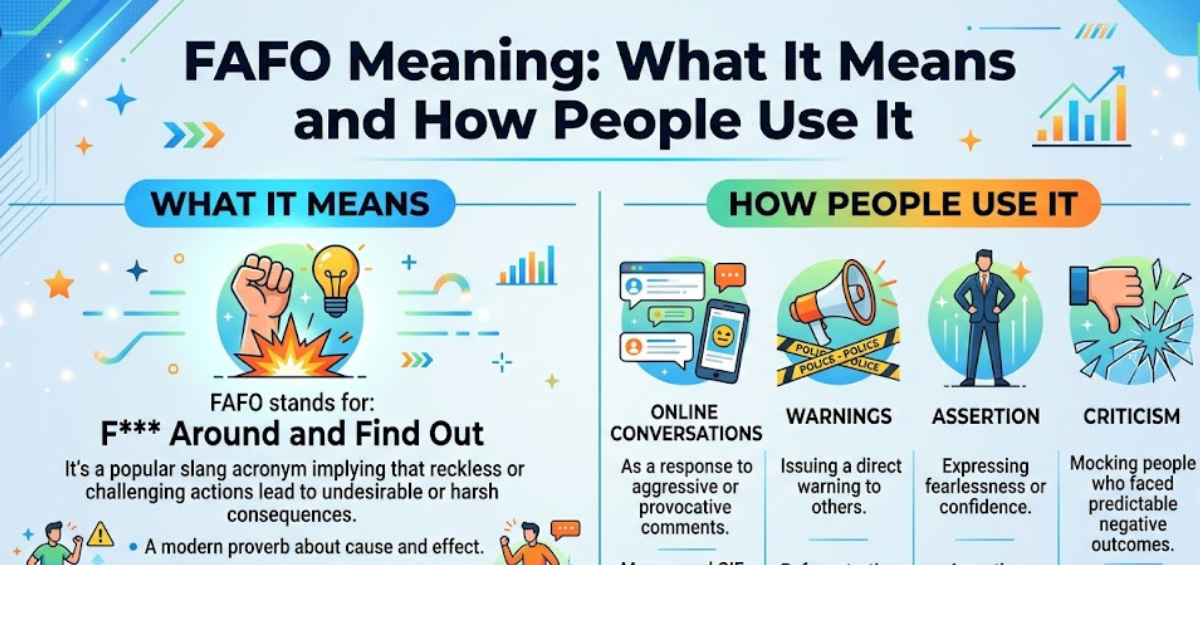
FAFO is an acronym for:
“F* Around and Find Out.”**
The phrase is a blunt way of saying that if someone takes unnecessary risks, ignores warnings, or behaves recklessly, they will eventually experience the consequences of their actions.
In simpler terms, FAFO means:
- Actions have consequences
- Risky behavior can lead to unpleasant outcomes
- People sometimes learn lessons the hard way
The expression is often used humorously, sarcastically, or as a warning.
Example
Someone ignores repeated instructions not to touch a hot stove and ends up getting burned.
A person might respond:
“Well, that’s FAFO.”
The implication is that the result was predictable.
The Origin of FAFO
While the exact origin is difficult to pinpoint, the phrase has existed in spoken English for decades. The acronym version, FAFO, gained popularity through:
- Internet forums
- Social media platforms
- Meme culture
- Gaming communities
- Military and law enforcement circles
As platforms like X (formerly Twitter), TikTok, Reddit, Instagram, and YouTube grew, FAFO became a convenient shorthand for describing situations where someone’s poor decisions led to obvious consequences.
The phrase exploded in popularity during the 2020s, appearing in memes, reaction videos, and viral news commentary.
Why Has FAFO Become So Popular?
Several factors explain the phrase’s widespread appeal.
It’s Short and Memorable
Internet users love concise expressions. FAFO communicates an entire idea in just four letters.
It Fits Meme Culture
Many viral videos show people making questionable decisions. FAFO provides an easy caption for these moments.
It Reflects Real-Life Consequences
People naturally understand cause and effect. The phrase captures a universal truth: choices often produce predictable outcomes.
It’s Versatile
FAFO can be used in serious discussions, humorous situations, sports commentary, politics, workplace conversations, and everyday life.
How FAFO Is Used Online
The phrase appears in a wide variety of contexts.
Social Media Reactions
Users often post FAFO when someone experiences consequences after ignoring warnings.
Example:
- Person attempts a dangerous stunt.
- Stunt fails spectacularly.
- Comments fill with “FAFO.”
Sports Discussions
Fans use the phrase when athletes or teams underestimate opponents.
Example:
“They talked trash all week and then lost by 30. FAFO.”
Gaming Communities
Gamers frequently use FAFO when players take unnecessary risks and lose.
News and Viral Stories
The acronym often appears in discussions about public incidents where poor decisions led to expected results.
Different Meanings and Interpretations
Although the core message remains the same, people interpret FAFO in different ways.
As a Warning
Sometimes it means:
“Don’t do that unless you’re prepared for the consequences.”
As a Lesson
It can suggest that experience is the best teacher.
As Humor
Many people use FAFO jokingly when discussing harmless mistakes.
As Criticism
In some situations, it carries a judgmental tone toward someone’s actions.
Understanding context is important because the phrase can sound playful or harsh depending on how it’s used.
Examples of FAFO in Everyday Life
Here are some practical examples.
Example 1: Workplace
An employee repeatedly ignores company policies despite multiple warnings.
Eventually, disciplinary action follows.
Response:
“That’s a classic FAFO situation.”
Example 2: School
A student waits until the night before an exam to study and fails.
Someone might say:
“They FAFO’d.”
Example 3: Sports
A team mocks its opponent before a game and then loses badly.
Fans may comment:
“FAFO.”
Example 4: Personal Finance
Someone takes on risky debt despite expert advice and later struggles financially.
The situation might be described as an example of “finding out” after “fooling around.”
FAFO vs Similar Internet Slang
Many slang phrases communicate related ideas, but there are subtle differences.
| Phrase | Meaning |
| FAFO | Actions lead to consequences |
| Karma | Good or bad actions eventually return to a person |
| Play stupid games, win stupid prizes | Foolish actions produce predictable negative outcomes |
| Consequences | Formal term for results of actions |
| Reap what you sow | Traditional expression with a similar meaning |
FAFO is generally more direct and informal than these alternatives.
When Should You Use FAFO?
The phrase works best in casual settings.
Appropriate situations include:
- Social media conversations
- Text messages
- Informal discussions
- Meme sharing
- Friendly banter
It can effectively summarize situations where consequences were predictable.
Practical Tip
Before using FAFO, consider:
- Your audience
- The setting
- Whether the phrase could seem insensitive
Because it contains implied profanity, some professional environments may view it as inappropriate.
When Not to Use FAFO
There are situations where the phrase may come across as rude or dismissive.
Avoid using it when:
- Someone is dealing with a serious tragedy
- Offering professional advice
- Communicating in formal business settings
- Speaking to audiences that may find profanity offensive
Context matters. What seems funny in a meme may feel insensitive in a serious conversation.
How FAFO Reflects Modern Internet Culture
The popularity of FAFO highlights several trends in digital communication.
Faster Communication
People increasingly prefer acronyms and shorthand expressions.
Meme-Based Language
Many internet phrases gain traction because they’re easy to share and adapt.
Emphasis on Accountability
FAFO resonates because it reinforces a widely accepted principle: actions have consequences.
Community Humor
Online communities often use the phrase as a shared joke that instantly communicates a familiar idea.
Key Takeaways
- FAFO stands for “F* Around and Find Out.”**
- The phrase means actions have consequences.
- It is commonly used on social media, forums, and in casual conversations.
- FAFO can be humorous, sarcastic, cautionary, or critical depending on context.
- The expression became popular through internet culture and viral content.
- It is best used in informal settings rather than professional environments.
Frequently Asked Questions
What is the FAFO meaning in slang?
In slang, FAFO stands for “F*** Around and Find Out.” It describes a situation where someone experiences consequences after taking unnecessary risks or ignoring warnings.
Is FAFO considered offensive?
The acronym itself is generally mild, but it represents a phrase containing profanity. Some people may consider it inappropriate in professional or formal settings.
Where did FAFO originate?
The phrase existed long before social media, but the acronym gained popularity through online communities, memes, gaming culture, and social platforms.
Why do people say FAFO online?
People use FAFO to comment on situations where someone faces predictable consequences after making poor decisions or taking reckless actions.
Is FAFO always negative?
Not necessarily. While it often refers to negative outcomes, it can also be used humorously when discussing harmless mistakes or learning experiences.
What are some alternatives to FAFO?
Similar expressions include “actions have consequences,” “karma,” “play stupid games, win stupid prizes,” and “reap what you sow.”
Conclusion
Understanding the FAFO meaning helps decode one of the internet’s most popular slang expressions. At its core, the phrase is a modern, memorable way of expressing an age-old lesson: our choices often determine our outcomes.
Whether you encounter it in memes, social media comments, sports discussions, or everyday conversations, FAFO serves as a reminder that actions have consequences. Knowing when and how to use the phrase can help you better understand online culture and communicate more effectively in today’s digital world.