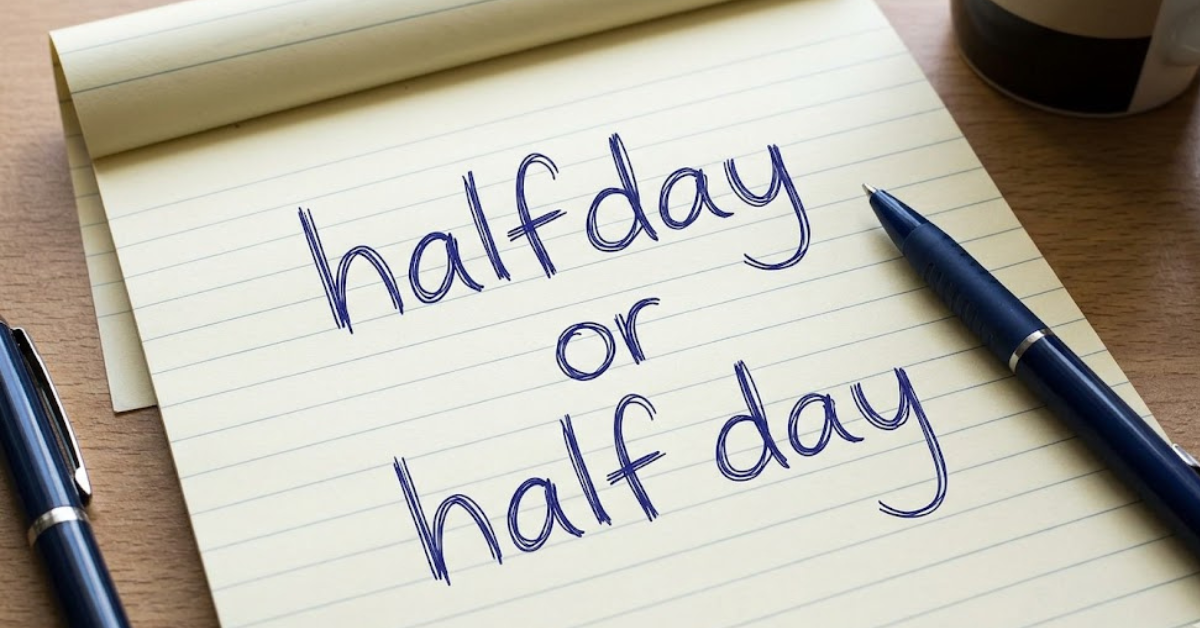
English can be surprisingly tricky. One small space can completely change whether a word looks correct or awkward. That’s exactly why so many people search for “halfday or half day” when writing emails, leave applications, schedules, or office messages.
The short answer? In most professional and grammatical contexts, “half day” is the correct form. While “halfday” occasionally appears online or in informal writing, it is generally considered nonstandard.
In this guide, we’ll break down the difference between halfday and half day, explain when to use each version, and show examples that sound natural in both casual and professional communication.
What Is the Correct Form: Halfday or Half Day?
The grammatically accepted form is “half day.”
Correct:
- I’m taking a half day tomorrow.
- The school has a half-day schedule on Friday.
- Employees may request half day leave.
Usually Incorrect or Nonstandard:
- I’m taking a halfday tomorrow.
The reason is simple: “half” and “day” function as separate words in standard English unless they’re combined as a compound modifier with a hyphen.
Why “Half Day” Is More Common
English often keeps quantity-related expressions separate.
For example:
- half hour
- half minute
- half year
- half day
Because “half” modifies the noun “day,” the two words generally remain separated.
That’s why half day appears far more frequently in:
- business writing
- academic English
- HR documents
- workplace communication
- dictionaries and style guides
When to Use “Half-Day” With a Hyphen
Here’s where things get interesting.
You should use “half-day” with a hyphen when it acts as an adjective before a noun.
Examples:
- We attended a half-day workshop.
- The company announced a half-day event.
- Students followed a half-day schedule.
In these cases, “half-day” works as a compound adjective describing another noun.
Quick Rule:
| Usage | Correct Form |
| Referring to time itself | half day |
| Describing another noun | half-day |
Is “Halfday” Ever Correct?
Technically, “halfday” is not widely accepted in formal English. Some websites, internal company systems, or regional usage may combine the words into one term, but major dictionaries generally prefer:
- half day
- half-day
So if you’re writing:
- emails
- resumes
- leave requests
- professional documents
- academic papers
…it’s best to avoid “halfday.”
Half Day in Workplace Communication
One of the most common uses of the phrase appears in office communication.
Examples of Natural Usage
Leave Request
“I would like to apply for a half day leave tomorrow afternoon.”
Team Message
“I’ll be working a half day on Friday due to an appointment.”
HR Policy
“Employees may take one paid half day per month.”
These examples sound polished, professional, and grammatically correct.
Common Mistakes People Make
When searching “halfday or half day,” many writers are unsure because compound words in English can be inconsistent.
Here are common mistakes:
1. Combining the Words Incorrectly
- Incorrect: halfday leave
- Better: half day leave
2. Forgetting the Hyphen
- Incorrect: half day meeting
- Correct: half-day meeting
3. Overusing Informal Spellings
Some spell-checkers may not flag “halfday,” but that doesn’t make it standard English.
Examples of Correct Usage
Here are some easy examples you can copy naturally into daily writing.
Using “Half Day”
- I took a half day from work.
- Today feels like a half day because business is slow.
- Schools often close after a half day before holidays.
Using “Half-Day”
- We attended a half-day training session.
- The office announced a half-day conference.
- Students followed a half-day timetable.
Why Grammar Matters in Professional Writing
Using the correct form may seem minor, but details matter in communication.
Correct grammar helps:
- emails look more professional
- applications appear polished
- workplace communication stay clear
- academic writing remain credible
Small corrections like choosing “half day” instead of “halfday” can improve readability instantly.
Easy Trick to Remember
Here’s a simple way to avoid confusion:
Ask Yourself:
“Am I describing another noun?”
If yes, use half-day with a hyphen.
If no, use half day as two separate words.
Examples:
- half day off
- half-day seminar
Half Day vs Half-Day: Quick Comparison
| Phrase | Usage | Example |
| half day | Noun phrase | I took a half day. |
| half-day | Compound adjective | We had a half-day meeting. |
| halfday | Nonstandard form | Usually avoided |
FAQs About Halfday or Half Day
Is “halfday” one word or two?
In standard English, it is usually written as two words: half day.
Which is correct: halfday or half day?
“Half day” is the preferred and grammatically accepted version.
When should I use “half-day” with a hyphen?
Use “half-day” before a noun, such as:
- half-day event
- half-day class
Is “halfday leave” correct?
The more professional version is:
- half day leave
or - half-day leave request
Do dictionaries recognize “halfday”?
Most major dictionaries prefer “half day” or “half-day” instead of the single-word form.
Conclusion
If you’ve been wondering whether to write “halfday or half day,” the safest and most professional choice is usually “half day.” When the phrase acts as an adjective before a noun, use the hyphenated form “half-day.”
While “halfday” occasionally appears online, it’s generally considered nonstandard in formal English. Using the correct form makes your writing clearer, more polished, and easier to understand.
The next time you draft an email, submit leave paperwork, or write a schedule, you’ll know exactly which version to use.