Have you ever read the words oar vs ore and wondered whether they mean the same thing? Although they sound identical when spoken, oar and ore have completely different meanings. This makes them a perfect example of homophones—words that share the same pronunciation but differ in spelling and definition.
Understanding the difference between oar vs ore can improve your vocabulary, writing accuracy, and communication skills. In this guide, we’ll explore their meanings, uses, origins, examples, and easy tricks to remember which word belongs in a particular context.
What Does Oar Mean?
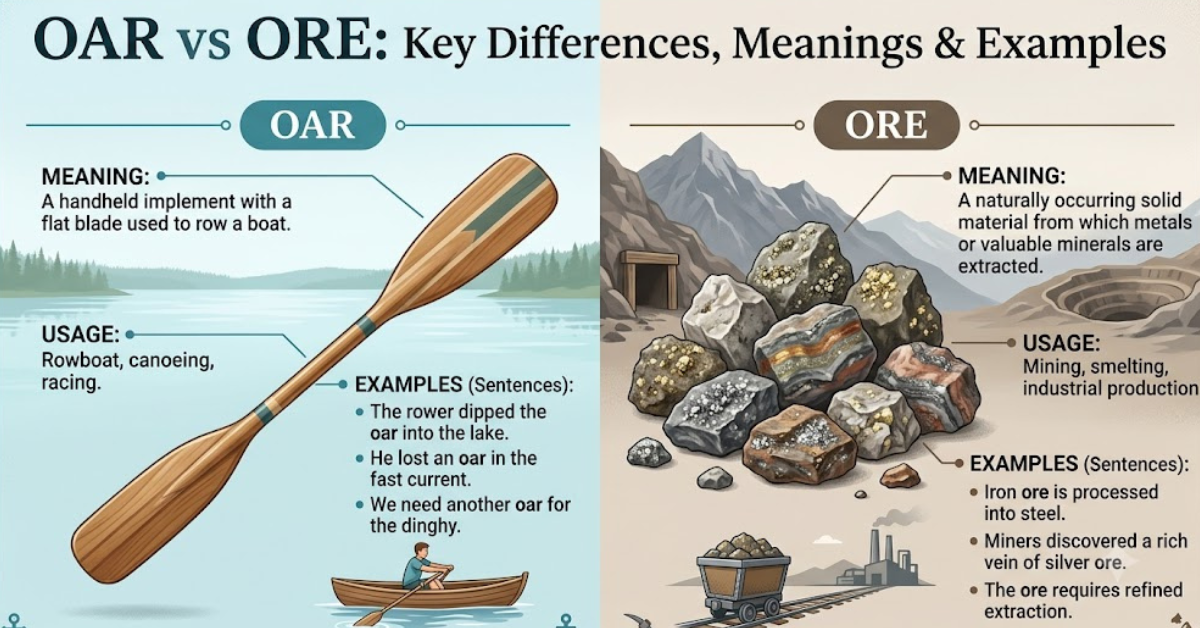
An oar is a long pole with a flat blade at one end that is used to row or steer a boat. It is a piece of equipment commonly found on rowboats, canoes, and other small watercraft.
The person operating an oar moves it through the water to create force, allowing the boat to move forward or change direction.
Examples of Oar in a Sentence
- The fisherman grabbed his oar and rowed toward the shore.
- She learned how to use an oar during her first rowing lesson.
- The old wooden oars were kept inside the boathouse.
Common Uses Related to Oars
The word oar frequently appears in contexts such as:
- Rowing and racing
- Fishing and boating
- Water sports
- Marine history and exploration
The word comes from the Old English ār, meaning a tool used for rowing a boat.
What Does Ore Mean?
Ore refers to a naturally occurring rock or mineral that contains valuable metals or elements. These materials are extracted through mining and processed to obtain useful substances such as iron, copper, gold, or aluminum.
In simple terms, ore is the raw material that miners remove from the Earth to produce metals.
Examples of Ore in a Sentence
- The company discovered a large deposit of iron ore underground.
- Gold ore must be processed before pure gold can be extracted.
- Miners transported the valuable ore to the processing facility.
Types of Common Ores
Some of the most important ores include:
- Iron ore – Used to make steel and construction materials.
- Copper ore – Essential for electrical wiring and electronics.
- Bauxite ore – The primary source of aluminum.
- Gold ore – A source of precious gold used in jewelry and technology.
The word ore originates from Old English ōra, referring to unrefined metal or mineral material.
Oar vs Ore: The Main Differences
Although the pronunciation is the same, the meanings of oar vs ore are entirely unrelated.
| Feature | Oar | Ore |
| Meaning | A tool used for rowing a boat | A rock containing valuable minerals or metals |
| Category | Boating equipment | Geological material |
| Found In | Boats and water environments | Mines and underground deposits |
| Purpose | Moves or steers a boat | Extracted to obtain metals |
| Example | “He picked up the oar.” | “They mined iron ore.” |
Oar and Ore: Why Are They Confused?
The confusion between oar and ore happens because they are homophones. In English, many words have the same pronunciation but different spellings and meanings.
Other examples of homophones include:
- Sea and see
- Flower and flour
- Right and write
- Knight and night
Because oar and ore sound exactly alike, the correct choice depends entirely on the topic being discussed.
Easy Tricks to Remember Oar vs Ore
A few memory tricks can help you choose the correct word every time.
Remember Oar = Ocean
The word oar starts with “O,” which can remind you of the ocean or other bodies of water. If the topic involves boats, rowing, or water, oar is usually the right choice.
Remember Ore = Earth
The word ore contains “re,” which can remind you of resources found in the earth. If you are talking about mining, metals, or rocks, ore is the correct spelling.
Oar vs Ore in Everyday Language
While the word oar appears more often in sports, travel, and nautical discussions, ore is common in geology, mining, engineering, and industry.
For example:
- A rower uses an oar to propel a boat across a lake.
- A miner extracts ore from deep beneath the ground.
The context of the sentence immediately reveals which word is appropriate.
Frequently Asked Questions FAQs
Is it oar or ore for a boat?
The correct word is oar. An oar is a rowing tool used to move or steer a boat.
Is iron an ore?
Iron itself is a metal, but iron ore is the natural rock that contains iron compounds from which the metal is extracted.
Are oar and ore pronounced the same?
Yes. Oar and ore are homophones, meaning they have the same pronunciation but different spellings and meanings.
What is the easiest way to remember oar vs ore?
Think of oar = water and boats, while ore = earth and mining.
Can ore be used in a sentence?
Yes. For example: “The miners discovered a rich deposit of copper ore in the mountains.”
Conclusion
Understanding oar vs ore is simple once you recognize their different meanings. An oar is a boating tool used to row through water, while ore is a natural rock containing valuable minerals and metals extracted from the earth.
Since these words are homophones, context is the key to choosing the correct one. Keep the memory trick “oar for water, ore for earth” in mind, and you’ll avoid this common English mistake. For more vocabulary comparisons and language guides, explore other articles that break down confusing words in a simple and practical way.