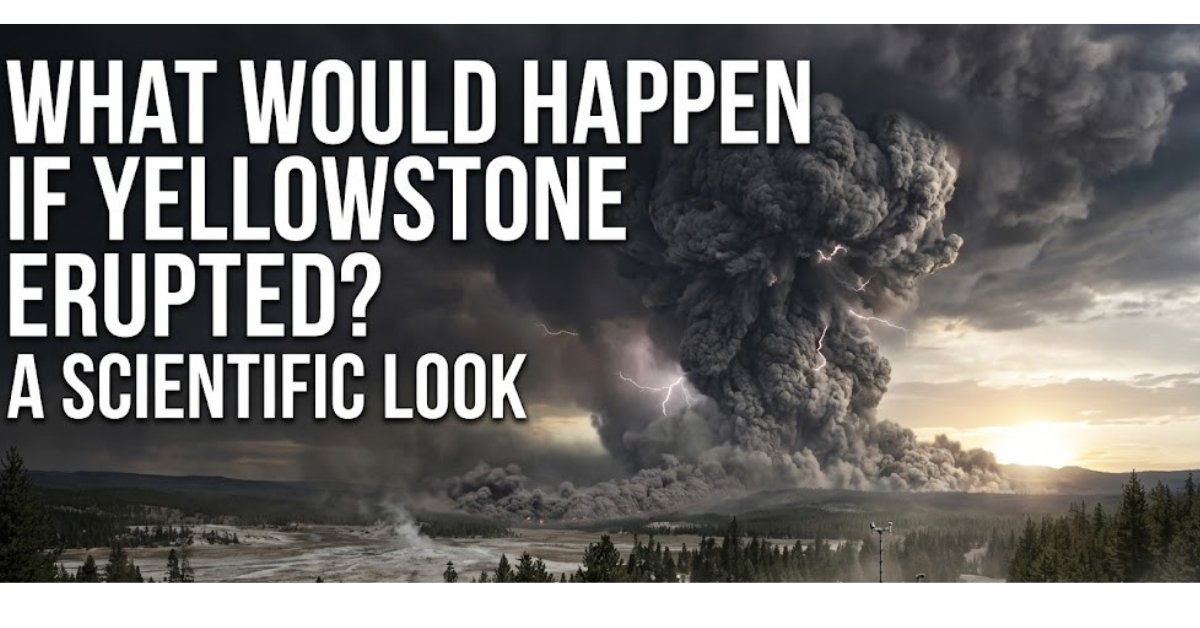
Imagine waking up to news that the massive Yellowstone volcano had finally erupted. The idea sounds like something straight out of a disaster movie, but many people wonder what would happen if Yellowstone erupted in real life. Would it destroy the world, block out the sun, or cause human extinction?
Yellowstone is home to one of the largest volcanic systems on Earth, known as the Yellowstone supervolcano. While scientists agree that a massive eruption is extremely unlikely in our lifetime, studying the possible consequences helps us understand the power of Earth’s geology and how society could be affected by such a rare event.
What Is the Yellowstone Supervolcano?
Before understanding what would happen if Yellowstone erupted, it’s important to know what makes Yellowstone unique.
Located primarily in Wyoming, the Yellowstone volcanic system sits above a giant reservoir of molten rock called a magma chamber. Unlike typical cone-shaped volcanoes, Yellowstone is a caldera volcano, meaning it has a large collapsed depression formed by previous enormous eruptions.
Yellowstone has experienced three major eruptions in its history:
- 2.1 million years ago – The Huckleberry Ridge eruption.
- 1.3 million years ago – The Mesa Falls eruption.
- Approximately 631,000 years ago – The Lava Creek eruption.
These eruptions released thousands of times more material than the 1980 Mount St. Helens eruption.
What Would Happen If Yellowstone Erupted Today?
If Yellowstone experienced a super-eruption today, the effects would vary based on distance from the volcano and the size of the eruption.
Massive Volcanic Ash Across North America
One of the biggest dangers would be volcanic ash fall.
Areas close to Yellowstone could receive thick layers of ash capable of:
- Collapsing roofs and damaging buildings
- Destroying crops and vegetation
- Contaminating water supplies
- Disrupting electricity and communication systems
- Causing respiratory problems in humans and animals
Even states hundreds or thousands of miles away could experience smaller amounts of ash. Air travel across large portions of North America could be severely disrupted for weeks or months.
Pyroclastic Flows and Immediate Destruction
The most devastating area would be near Yellowstone itself.
A large eruption could produce pyroclastic flows—extremely hot clouds of gas, ash, and volcanic material that move at high speeds. These flows can reach temperatures of hundreds of degrees Celsius and destroy nearly everything in their path.
However, their effects would primarily be limited to the surrounding region rather than the entire United States.
Global Climate Changes and a “Volcanic Winte”
One of the most significant long-term consequences of a Yellowstone super-eruption could be changes to the global climate.
Large amounts of sulfur gases released into the atmosphere could form tiny particles that reflect sunlight, potentially causing a temporary cooling period known as a volcanic winter.
Possible climate impacts include:
- Lower global temperatures for several years
- Shorter growing seasons
- Reduced agricultural production
- Food shortages and economic stress
The severity would depend on the amount of material released into the atmosphere.
Would a Yellowstone Eruption Cause Human Extinction?
A common myth is that Yellowstone erupting would wipe out all life on Earth. Current scientific understanding does not support this idea.
A super-eruption would be an enormous disaster with major consequences for millions of people and the global economy, but humanity would likely survive.
Modern technology, global food networks, emergency planning, and international cooperation would play important roles in reducing the impact.
How Likely Is Yellowstone to Erupt?
Although Yellowstone is still an active volcanic system with earthquakes, hot springs, and geysers, scientists monitor it constantly.
According to geological research:
- The probability of a Yellowstone super-eruption in any given year is extremely low.
- Small earthquakes are normal and do not necessarily signal an eruption.
- Ground movement and geothermal activity are expected features of the Yellowstone area.
The Yellowstone Volcano Observatory uses seismic sensors, satellite measurements, and other technologies to detect signs of unusual volcanic activity.
What Warning Signs Would Scientists Look For?
A supervolcanic eruption would likely be preceded by significant geological changes, such as:
- Increased earthquake activity
- Rapid ground uplift or deformation
- Changes in gas emissions
- Unusual changes in hydrothermal systems
Scientists believe these warning signs would probably appear well before a large eruption, giving authorities time to respond.
How Would the Economy and Daily Life Be Affected?
A major Yellowstone eruption would have worldwide economic consequences.
Potential disruptions could include:
Transportation Problems
- Airports could close due to dangerous ash clouds.
- Roads and rail systems could become unusable in heavily affected regions.
Food Supply Issues
- Ash-covered farmland could reduce crop production.
- Climate cooling could lead to lower agricultural yields worldwide.
Economic Losses
The costs of recovery could reach trillions of dollars due to damaged infrastructure, healthcare challenges, and long-term environmental impacts.
Could Yellowstone Be Prevented from Erupting?
Scientists currently have no practical way to stop a supervolcano from erupting.
Ideas such as drilling into the magma chamber or artificially cooling it have been discussed, but these remain theoretical and involve significant technical challenges and risks.
For now, the best defense is careful monitoring, scientific research, and emergency preparedness.
FAQs About What Would Happen If Yellowstone Erupted
Would Yellowstone erupt in our lifetime?
Scientists cannot predict exactly when Yellowstone will erupt, but a massive super-eruption is considered extremely unlikely in the foreseeable future.
How much of the United States would be destroyed?
The areas closest to Yellowstone would experience the most severe destruction. Ash could spread across much of the United States, but the entire country would not be destroyed.
Could a Yellowstone eruption end the world?
No. While it could cause a major global disaster with severe environmental and economic effects, it would not destroy the planet or eliminate humanity.
How long would a volcanic winter last?
A volcanic winter from a super-eruption could potentially last several years, depending on how much sulfur and ash entered the atmosphere.
Is Yellowstone showing signs of an upcoming eruption?
No evidence currently suggests that Yellowstone is heading toward a catastrophic eruption. Normal earthquakes, geyser activity, and ground movement are expected features of the area.
Conclusion
So, what would happen if Yellowstone erupted? The answer is both terrifying and fascinating. A large super-eruption could produce widespread ash fall, regional devastation, temporary climate cooling, and major economic disruption across the globe. However, it would not mean the end of humanity or life on Earth.
The good news is that the chances of such an event happening anytime soon are extremely low, and scientists continuously monitor Yellowstone for signs of unusual activity. If you’re fascinated by volcanoes, Earth’s history, and natural disasters, exploring more about supervolcanoes and geological science reveals just how powerful—and unpredictable—our planet truly is.