
Have you ever stopped while writing and wondered whether to use peace vs piece? You’re not alone. These two English words sound exactly the same, making them classic examples of homophones—words that share the same pronunciation but have different meanings and spellings.
Understanding the difference between peace and piece can improve your writing, prevent embarrassing mistakes, and help you communicate more clearly. In this guide, we’ll explore their meanings, usage, examples, and easy tricks to remember which word belongs where.
What Does “Peace” Mean?
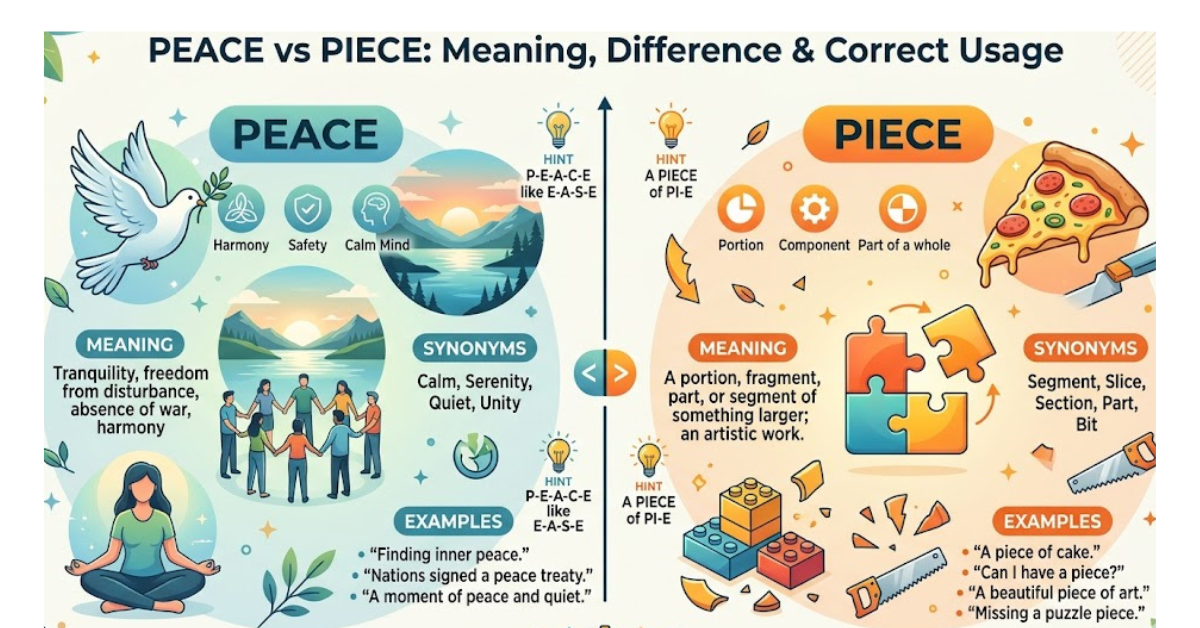
Peace refers to a state of calm, harmony, or the absence of conflict. It is commonly associated with emotional tranquility, social harmony, and freedom from war or disturbance.
Common Meanings of Peace
- A feeling of inner calm or mental quietness
- Harmony between individuals or nations
- Freedom from violence, conflict, or stress
Examples of Peace in Sentences
- She found peace after spending time in nature.
- The two countries signed an agreement to maintain peace.
- Meditation helps many people achieve inner peace.
- I finally made peace with my past.
Common Phrases with Peace
Some popular expressions include:
- Peace of mind – freedom from worry
- Rest in peace (RIP) – a phrase used to honor someone who has died
- World peace – a state where nations live without war
- Keep the peace – prevent arguments or violence
What Does “Piece” Mean?
A piece is a part, portion, or individual item that belongs to a larger whole. It can refer to physical objects, creative works, or portions of information.
Common Meanings of Piece
- A part broken or separated from something larger
- A single item in a collection
- A work of art, writing, or music
- A small amount or portion of something
Examples of Piece in Sentences
- She ate a piece of chocolate cake.
- I found a missing piece of the puzzle.
- The artist displayed a beautiful piece of artwork.
- He wrote a thoughtful piece for the newspaper.
Common Phrases with Piece
- A piece of cake – something very easy
- Piece by piece – gradually or one part at a time
- A piece of the action – a share in an activity or success
- Masterpiece – an outstanding work of art or skill
Peace vs Piece: Key Differences at a Glance
| Feature | Peace | Piece |
| Meaning | Calm, harmony, absence of conflict | A part or portion of something |
| Related to | Emotions, relationships, war, quietness | Objects, food, art, information |
| Part of Speech | Noun | Noun |
| Example | “I feel at peace today.” | “Please give me a piece of bread.” |
Although peace vs piece sounds confusing because the pronunciation is identical, remembering their different contexts makes choosing the right word much easier.
How to Remember Peace vs Piece
A simple memory trick can help you avoid mistakes.
Remember “Peace” with Calm
The word peace contains the letters “ea,” which can remind you of ease and relaxation. When you think of calmness, harmony, or quiet, choose peace.
Example:
- “The peaceful garden gave me a sense of peace.”
Remember “Piece” as a Part
The word piece refers to something you can divide or hold as a part of a whole.
Example:
- “Each piece of the puzzle fits perfectly.”
Why Are Peace and Piece Confused?
The confusion between peace and piece happens because they are homophones. In English, many words share the same sound while having different meanings and spellings.
Other common examples include:
- Their vs There vs They’re
- To vs Too vs Two
- Hear vs Here
- Brake vs Break
Learning these differences helps improve grammar, spelling accuracy, and overall communication skills.
Common Mistakes When Using Peace and Piece
Here are some examples of incorrect and correct usage:
Incorrect:
I need a little peace of cake.
Correct:
I need a little piece of cake.
Incorrect:
She finally found inner piece.
Correct:
She finally found inner peace.
Paying attention to the context of your sentence will usually tell you which word is appropriate.
Peace vs Piece in Everyday English
Both words are frequently used in conversations, books, media, and professional writing.
You will often hear peace in discussions about:
- Mental health and mindfulness
- International relationships
- Personal emotions
- Spiritual practices
Meanwhile, piece commonly appears in contexts involving:
- Food portions
- Objects and materials
- Art and literature
- Games like puzzles or chess
Knowing the difference makes your English sound more natural and polished.
FAQs About Peace vs Piece
Are peace and piece pronounced the same?
Yes. Peace and piece are homophones, meaning they have the same pronunciation but different meanings and spellings.
What is the difference between peace and piece?
Peace means calm, harmony, or absence of conflict, while piece means a part, portion, or individual item of something larger.
How do I remember whether to use peace or piece?
Think of peace as emotional ease and calm. Think of piece as a part of something, like a piece of a puzzle or a piece of cake.
Is “peace of cake” correct?
No. The correct expression is “piece of cake,” which means something that is very easy to do.
Can peace and piece be used interchangeably?
No. Even though they sound identical, their meanings are completely different and they cannot replace each other in sentences.
Conclusion
The difference between peace vs piece is simple once you understand their meanings. Peace represents calm, harmony, and the absence of conflict, while piece refers to a part or portion of something larger. Since these words sound alike, they are often confused, but the surrounding context makes the correct choice clear.
By practicing their usage and remembering the simple memory tricks in this guide, you can avoid common spelling mistakes and write with greater confidence. Continue exploring other commonly confused words to strengthen your English vocabulary and communication skills.