
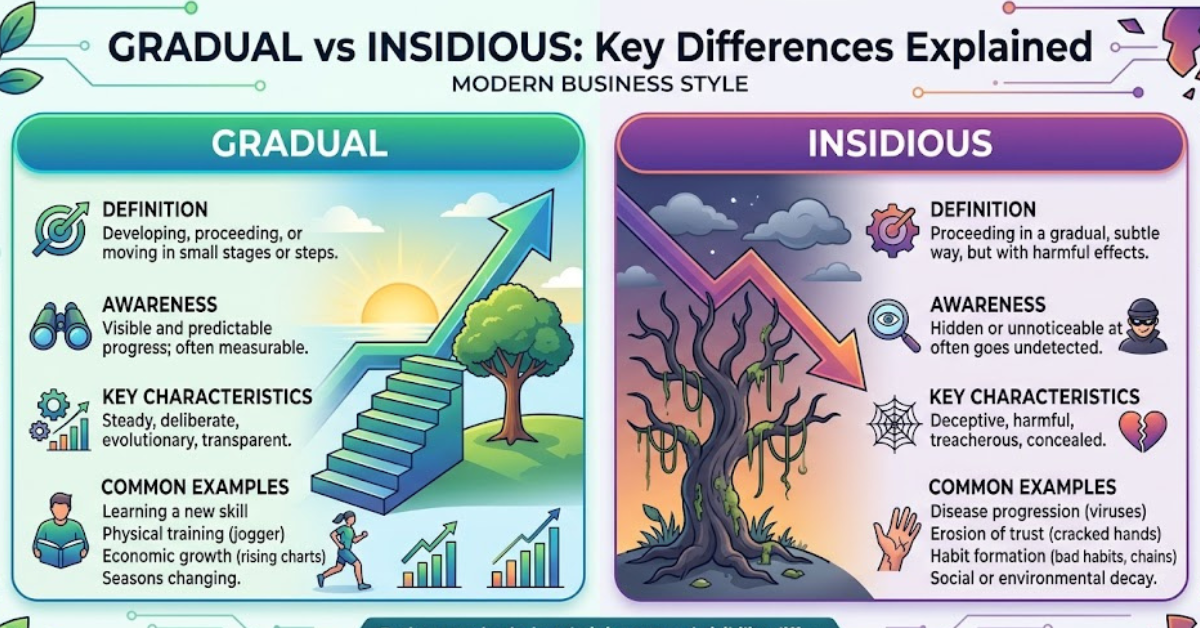
Have you ever heard someone describe a change as gradual while another person calls it insidious? At first glance, these words can seem similar because both often refer to something that develops over time. However, they carry very different meanings and implications.
Understanding Gradual vs Insidious is important in everyday communication, healthcare, psychology, business, and even environmental discussions. Misusing these terms can change the meaning of a sentence entirely.
In this guide, you’ll learn the precise definitions, key differences, real-world examples, and practical ways to use both words correctly.
What Does “Gradual” Mean?
The word gradual refers to something that happens slowly, steadily, and in small stages over time.
A gradual process is typically noticeable if you observe it long enough, even though the individual changes may be small.
Characteristics of Gradual Change
- Occurs step by step
- Progresses steadily
- Usually neutral in meaning
- Can be positive, negative, or neither
- Often expected or predictable
Examples of Gradual Changes
- A child gradually learning to read
- Seasonal temperature changes
- A company slowly increasing its market share
- Recovering from an injury over several months
- Gradual improvement in fitness levels
In each case, the change happens progressively rather than suddenly.
Example Sentence
“The patient’s condition showed gradual improvement after several weeks of treatment.”
Here, “gradual” simply describes the pace of improvement without suggesting anything harmful.
What Does “Insidious” Mean?
The word insidious describes something that develops gradually but in a harmful, deceptive, or dangerous way.
Unlike gradual, insidious carries a strong negative connotation. It often refers to threats that are difficult to detect until significant damage has already occurred.
Characteristics of Insidious Processes
- Develop slowly over time
- Often hidden or subtle
- Usually harmful
- Difficult to recognize initially
- May cause damage before becoming obvious
Examples of Insidious Developments
- Certain diseases that show few early symptoms
- Workplace toxicity that slowly affects morale
- Financial fraud schemes
- Addiction developing unnoticed
- Misinformation influencing public opinion over time
Example Sentence
“The insidious effects of chronic stress can damage both physical and mental health.”
In this example, the danger grows quietly and may not be immediately apparent.
Gradual vs Insidious: The Core Difference
The most important distinction is that all insidious processes are gradual, but not all gradual processes are insidious.
Gradual simply describes the speed or manner of change.
Insidious describes both the slow development and the hidden harmful nature of that development.
| Feature | Gradual | Insidious |
| Develops over time | Yes | Yes |
| Slow progression | Yes | Yes |
| Negative meaning | Not necessarily | Yes |
| Hidden or deceptive | Not usually | Often |
| Harmful effect | Optional | Usually present |
| Emotional tone | Neutral | Negative |
This distinction makes Gradual vs Insidious a matter of both timing and intent or impact.
Why People Confuse Gradual and Insidious
The confusion arises because both words involve change occurring over time.
However, people sometimes focus only on the “slow development” aspect and overlook the negative implications attached to “insidious.”
Common Mistake
Incorrect:
“She made insidious progress in learning Spanish.”
Correct:
“She made gradual progress in learning Spanish.”
Language learning is generally positive, so “gradual” is the appropriate choice.
When Insidious Fits Better
“The insidious spread of misinformation influenced public opinion before experts could respond.”
Here, the development is slow, subtle, and harmful.
Gradual vs Insidious in Healthcare
Healthcare provides one of the clearest examples of the difference.
Gradual Medical Changes
Some health improvements occur gradually:
- Muscle recovery after surgery
- Weight loss through diet and exercise
- Improved cardiovascular fitness
These developments are slow but beneficial.
Insidious Medical Conditions
Certain illnesses are often described as insidious because symptoms appear slowly and may go unnoticed.
Examples include:
- Type 2 diabetes
- Osteoporosis
- High blood pressure
- Some forms of cancer
- Chronic kidney disease
Doctors frequently use the term “insidious onset” when symptoms emerge subtly and progressively.
Example
A gradual recovery is positive.
An insidious disease progression is concerning because the damage may occur before diagnosis.
Gradual vs Insidious in Psychology
Psychologists and mental health professionals often distinguish between ordinary gradual changes and insidious influences.
Gradual Psychological Development
- Building confidence over time
- Learning coping skills
- Emotional maturity
- Personal growth
These changes occur naturally and progressively.
Insidious Psychological Effects
- Emotional manipulation
- Gaslighting
- Chronic stress
- Burnout
- Negative self-talk patterns
These influences may slowly alter thoughts and behaviors without immediate awareness.
Gradual vs Insidious in Business and Organizations
Organizations frequently experience both gradual and insidious changes.
Gradual Business Growth
Examples include:
- Expanding customer bases
- Increasing revenue
- Developing employee skills
- Improving operational efficiency
These are generally healthy developments.
Insidious Organizational Problems
Examples include:
- Toxic workplace culture
- Ethical lapses
- Declining employee engagement
- Hidden cybersecurity threats
- Corruption
Because these issues emerge quietly, leaders may not recognize them until they become serious.
Gradual vs Insidious in Environmental Issues
Environmental discussions often highlight the distinction between these terms.
Gradual Environmental Changes
- Natural erosion
- Seasonal climate variations
- Forest regeneration
These changes may occur slowly and naturally.
Insidious Environmental Threats
- Microplastic accumulation
- Soil contamination
- Long-term pollution exposure
- Biodiversity loss
These problems often worsen quietly and become evident only after significant ecological damage.
How to Decide Which Word to Use
When choosing between gradual and insidious, ask yourself three questions:
1. Is the change happening slowly?
If yes, either word may potentially apply.
2. Is the change harmful?
If no, use gradual.
If yes, continue.
3. Is the harm subtle or difficult to notice?
If yes, insidious is likely the better choice.
Quick Rule
- Gradual = slow
- Insidious = slow + harmful + subtle
This simple formula helps avoid most usage errors.
Common Examples Side by Side
Example 1: Learning
Gradual: Learning a new language over several years.
Insidious: Developing self-doubt due to repeated criticism.
Example 2: Health
Gradual: Regaining strength after physical therapy.
Insidious: High blood pressure causing damage without obvious symptoms.
Example 3: Workplace
Gradual: Expanding a team over time.
Insidious: Toxic behaviors slowly undermining morale.
Example 4: Technology
Gradual: Software improvements released over multiple updates.
Insidious: Malware collecting data unnoticed for months.
Key Takeaways
- Both words describe developments that occur over time.
- Gradual is generally neutral and focuses on pace.
- Insidious always implies a harmful or dangerous element.
- An insidious process is often difficult to detect initially.
- Not every gradual change is negative.
- Understanding context is essential when choosing the correct term.
Frequently Asked Questions
What is the main difference between gradual and insidious?
The primary difference is that gradual simply means slow and progressive, while insidious means slow, subtle, and harmful.
Can something be both gradual and insidious?
Yes. Many insidious processes are also gradual because they develop slowly over time. The added element is hidden harm.
Is insidious always negative?
Generally, yes. The word almost always carries a negative meaning involving danger, harm, or deception.
What does “insidious onset” mean in medicine?
It refers to symptoms that develop slowly and subtly, often making a condition difficult to recognize in its early stages.
Is gradual a positive word?
Not necessarily. Gradual is usually neutral and can describe positive, negative, or neutral changes depending on context.
Why do writers use the word insidious?
Writers use it to emphasize hidden dangers that emerge slowly and may not be recognized until significant consequences occur.
Conclusion
The debate around Gradual vs Insidious comes down to more than just the speed of change. While both describe developments that unfold over time, gradual focuses on steady progression, whereas insidious highlights hidden, harmful effects that may go unnoticed until serious damage has occurred.
Recognizing this distinction can improve your communication, writing, and understanding of complex issues in health, psychology, business, and everyday life. The next time you encounter a slow-moving change, consider not only how fast it’s happening but also whether it carries any concealed risks. Doing so will help you choose the right word with confidence and precision.