Have you ever come across the words Wholey and Wholly and wondered whether they’re actually the same word spelled differently? You’re not alone. Many English learners, writers, and even native speakers get confused when comparing Wholey vs Wholly, especially because the words look and sound similar.
The truth is that these two terms have very different meanings and uses. One is a common English adverb used in everyday writing, while the other is far less common and often appears as a surname or brand name. In this guide, you’ll learn exactly what each word means, when to use it, common mistakes to avoid, and practical examples that make the distinction crystal clear.
Understanding Wholey vs Wholly
At first glance, the difference between these words seems minor—just one letter. However, that single letter changes everything.
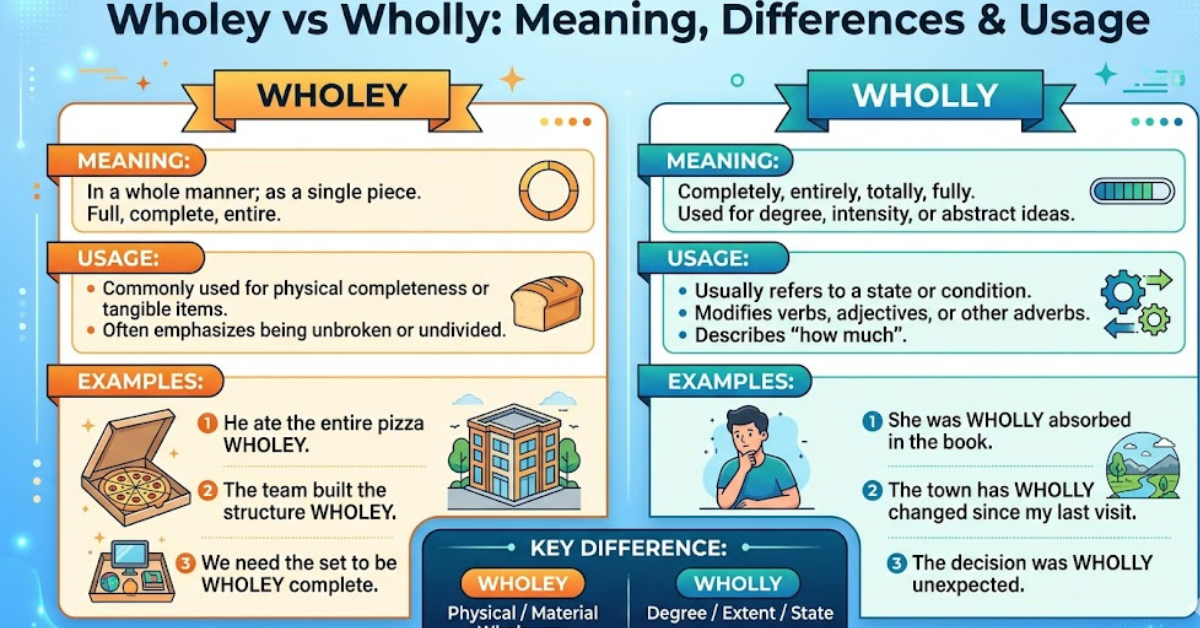
| Word | Part of Speech | Meaning |
| Wholly | Adverb | Completely, entirely, fully |
| Wholey | Proper noun or surname | Usually a family name, brand name, or company name |
In standard English grammar, wholly is the word most people need. Wholey is rarely used as a dictionary word and is generally associated with names rather than descriptions.
What Does Wholly Mean?
Wholly is an adverb that means:
- Completely
- Entirely
- Totally
- Fully
It is commonly used in formal and informal writing to emphasize that something is complete or absolute.
Examples of Wholly in Sentences
- I am wholly committed to this project.
- The decision was wholly unexpected.
- She was wholly responsible for the outcome.
- The report is not wholly accurate.
In each example, the word could often be replaced with “completely” or “entirely.”
Why Wholly Is Common in English
The word comes from the adjective whole, meaning complete or entire. Over time, wholly developed as the adverb form.
For example:
- Whole = complete
- Wholly = completely
This makes it a natural and widely accepted part of modern English.
What Does Wholey Mean?
Unlike wholly, Wholey is not commonly recognized as a standard English adverb.
Most often, Wholey appears as:
- A surname
- A company name
- A brand name
- A proper noun
Examples of Wholey as a Name
- John Wholey attended the conference.
- Wholey Foods launched a new product line.
- The Wholey family has lived here for generations.
In these situations, Wholey functions as a name rather than a descriptive word.
Is Wholey a Real Word?
Technically, yes—it exists as a surname and proper noun. However, it is not generally used to mean “completely” or “entirely.”
This distinction is where many spelling errors occur.
Key Differences Between Wholey and Wholly
Understanding the comparison becomes easier when viewed side by side.
Meaning
Wholly
- Means completely or entirely.
- Functions as an adverb.
Wholey
- Usually a name.
- Functions as a proper noun.
Usage
Wholly
- Used in essays, books, emails, and everyday communication.
Wholey
- Used primarily when referring to a person, family, company, or brand.
Example Comparison
Correct:
- I am wholly satisfied with the results.
Incorrect:
- I am wholey satisfied with the results.
Correct:
- Mr. Wholey will lead the meeting.
Incorrect:
- Mr. Wholly will lead the meeting. (Unless that is actually his name.)
Why People Confuse Wholey and Wholly
Several factors contribute to the confusion.
Similar Pronunciation
In many accents, the two words sound nearly identical. When spoken aloud, listeners may not immediately know which spelling is intended.
Spell-Check Limitations
Because Wholey can be a legitimate surname, some spell-check tools may not flag it as an error.
Visual Similarity
The words differ by only one letter:
- Wholey
- Wholly
This small difference makes typographical mistakes common.
Lack of Familiarity
Many people encounter wholly regularly but rarely see Wholey. When they do, they may assume it’s simply an alternative spelling.
Common Mistakes to Avoid
Mistake #1: Using Wholey Instead of Wholly
Incorrect:
- The company is wholey owned by investors.
Correct:
- The company is wholly owned by investors.
Mistake #2: Assuming They’re Interchangeable
These words are not interchangeable.
Incorrect:
- The proposal was wholey accepted.
Correct:
- The proposal was wholly accepted.
Mistake #3: Ignoring Context
If you’re describing the degree or completeness of something, wholly is almost always the correct choice.
Memory Tricks for Choosing the Right Word
Simple memory devices can help you remember the difference.
Remember the Meaning
Wholly = Whole + Completely
If you can replace the word with:
- Completely
- Entirely
- Totally
Then use wholly.
Think of Names
If the word refers to:
- A person
- A family
- A business
Then Wholey may be correct.
Quick Test
Replace the word with “completely.”
Example:
- I am completely convinced.
Therefore:
- I am wholly convinced.
Examples in Everyday Writing
Business Writing
- The company is wholly owned by its founders.
- The proposal is not wholly practical.
Academic Writing
- The findings are not wholly consistent with previous research.
- The theory is wholly dependent on available evidence.
Personal Communication
- I’m wholly grateful for your support.
- She wasn’t wholly sure about the decision.
Proper Name Usage
- Sarah Wholey joined the board.
- The Wholey Group announced its expansion plans.
Grammar Notes: Is Wholly Formal or Informal?
One reason wholly remains popular is its flexibility.
It works in:
- Formal reports
- Academic papers
- Professional emails
- Casual conversations
- News articles
Examples:
Formal:
- The organization is wholly funded through donations.
Informal:
- I’m wholly impressed by your work.
The word sounds slightly more polished than “totally” while retaining the same general meaning.
When Should You Use Wholly?
Use wholly when you want to express complete agreement, ownership, responsibility, commitment, or certainty.
Common phrases include:
- Wholly owned subsidiary
- Wholly responsible
- Wholly committed
- Wholly independent
- Wholly accurate
- Wholly unacceptable
These expressions are widely recognized in professional and everyday English.
Key Takeaways
- Wholly means completely, entirely, or fully.
- Wholey is generally a surname, company name, or proper noun.
- The two words are not interchangeable.
- Most grammar-related situations require wholly.
- Use context to determine whether you’re referring to completeness or a name.
- If “completely” fits the sentence, wholly is usually correct.
Frequently Asked Questions
Is Wholey a correct spelling of wholly?
No. If you mean “completely” or “entirely,” the correct spelling is wholly. Wholey is usually a surname or proper name.
What does wholly mean in English?
Wholly means completely, entirely, fully, or totally. It is an adverb used to emphasize completeness.
Can Wholey and Wholly be used interchangeably?
No. In the Wholey vs Wholly comparison, the words serve different purposes. One is an adverb, while the other is generally a proper noun.
Why do people misspell wholly as Wholey?
The words look and sound similar. Because Wholey can be a legitimate surname, spelling errors sometimes go unnoticed.
Is wholly formal English?
Yes, but it is also commonly used in everyday communication. It appears frequently in business, legal, academic, and general writing.
What is an example of wholly in a sentence?
A simple example is: “She was wholly dedicated to achieving her goals.” Here, wholly means completely.
Conclusion
Understanding Wholey vs Wholly is easier once you recognize their distinct roles. Wholly is the standard English adverb meaning completely or entirely, while Wholey is most often used as a surname, brand name, or other proper noun. Although they may sound alike, their meanings and applications are quite different.
The next time you encounter these words, focus on context. If you’re describing something as complete or total, choose wholly. If you’re referring to a person’s name or a business name, Wholey may be correct. Mastering this small distinction can make your writing more accurate, professional, and polished.