
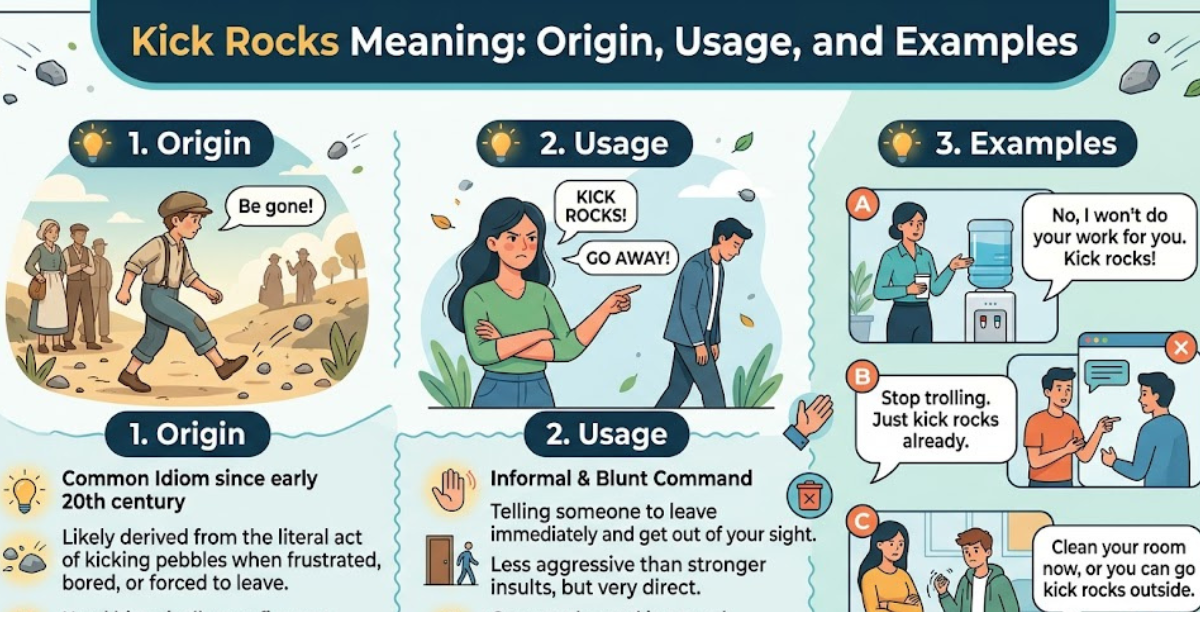
Have you ever heard someone say, “Go kick rocks” and wondered what they meant? The phrase may sound harmless at first, but its meaning can be surprisingly sharp depending on the context. Understanding the kick rocks meaning can help you recognize when it’s being used as a joke, an insult, or a way to dismiss someone.
In modern slang and everyday conversation, go kick rocks meaning generally refers to telling someone to leave, stop bothering you, or go away. While it’s less aggressive than some other expressions, it still carries a clear message. This guide explores the phrase’s definition, origin, examples, and common variations so you can understand exactly what does it mean to kick rocks.
What Is the Kick Rocks Meaning?
The phrase kick rocks is an informal expression used to tell someone to leave, go away, or stop wasting time.
In simple terms, when someone says “go kick rocks,” they’re essentially saying:
- “Leave me alone.”
- “Go do something else.”
- “Get lost.”
- “I don’t want to deal with this.”
The expression often carries a dismissive tone, though it can also be used humorously among friends.
Example:
Person A: “Can I borrow your car again this weekend?”
Person B: “No way. Go kick rocks.”
In this example, Person B is firmly rejecting the request and telling Person A to stop asking.
What Does It Mean to Kick Rocks?
If you’re asking what does it mean to kick rocks, the phrase paints a picture of someone wandering aimlessly and kicking stones on the ground because they have nothing better to do.
The underlying message is:
“Go occupy yourself somewhere else.”
Rather than engaging in an argument or continuing a conversation, the speaker dismisses the other person entirely.
Go Kick Rocks Meaning in Modern Slang
The go kick rocks meaning has become increasingly popular in casual speech, social media posts, memes, and online discussions.
Today, people use it to:
- Express annoyance
- Reject a request
- Dismiss criticism
- End an unwanted conversation
- Playfully tease friends
Unlike harsher insults, “go kick rocks” often sounds more humorous and creative, making it a popular alternative to stronger language.
Social Media Example
Someone might comment:
“If you think pineapple doesn’t belong on pizza, go kick rocks.”
In this context, the phrase is used jokingly rather than seriously.
The Origin of the Phrase “Kick Rocks”
The exact origin of kick rocks isn’t completely documented, but language experts generally believe it developed from imagery associated with boredom, wandering, and being sent away.
Historically, people walking down dirt roads might kick small stones while traveling with no particular purpose. Over time, telling someone to “go kick rocks” evolved into a way of saying:
“Go find something pointless to do instead of bothering me.”
The phrase became more widespread in American slang during the late 20th century and continues to be used today.
Kicking Rocks Meaning: Is It Different?
Many people search for kicking rocks meaning, and while it’s related, the phrase can have a slightly different interpretation depending on context.
As an Action
“Kicking rocks” can literally describe someone walking while kicking stones.
As an Idiom
Figuratively, kicking rocks often suggests:
- Feeling disappointed
- Leaving after rejection
- Walking away defeated
- Being dismissed
Example:
“After losing the game, the team was kicking rocks all the way back to the bus.”
Here, the phrase symbolizes disappointment and frustration.
How to Use “Go Kick Rocks” Correctly
Understanding context is important before using this expression.
Appropriate Situations
You can use go kick rocks when:
- Joking with friends
- Responding playfully to teasing
- Expressing mild irritation
- Creating humorous content
Situations to Avoid
It’s usually best not to use the phrase:
- In professional settings
- During serious disagreements
- With customers or clients
- When speaking to authority figures
Even though it’s relatively mild, it can still sound disrespectful.
Examples of Kick Rocks in Everyday Conversations
Here are some real-world examples showing how the phrase works.
Example 1: Friendly Banter
Friend: “You’re still using that old phone?”
You: “Go kick rocks. It works perfectly.”
Example 2: Dismissing a Suggestion
Coworker: “You should stay late again tonight.”
Employee: “Yeah, you can go kick rocks with that idea.”
Example 3: Social Media Humor
“Anyone who skips dessert can kick rocks.”
Example 4: Mild Frustration
Sibling: “Can I have your last cookie?”
Response: “Nope. Go kick rocks.”
Similar Expressions and Alternatives
If you understand the kick rocks meaning, you may also recognize these similar phrases.
Mild Alternatives
- Go away
- Leave me alone
- Move along
- Find something else to do
- Take a hike
Stronger Alternatives
- Get lost
- Buzz off
- Beat it
- Take a hike
Among these options, go kick rocks is often considered one of the more playful and less offensive choices.
Why Has “Go Kick Rocks” Become So Popular?
The phrase has gained popularity because it’s:
Creative
It communicates annoyance without using profanity.
Funny
The image of someone literally kicking rocks makes the phrase memorable.
Social Media Friendly
Short, witty expressions perform well online, making “go kick rocks” a favorite in memes and comments.
Less Aggressive
People can express frustration without sounding overly hostile.
Common Misunderstandings About Kick Rocks
Some people assume the phrase refers to physical violence or punishment. That’s not the case.
What It Doesn’t Mean
- It isn’t a threat.
- It isn’t an instruction meant to be taken literally.
- It doesn’t involve physical harm.
Instead, it’s simply an idiomatic expression used to dismiss someone or tell them to go away.
Is “Go Kick Rocks” Offensive?
The answer depends on tone and context.
Usually Not Offensive
When used among friends, it often sounds playful and humorous.
Potentially Rude
When directed at strangers or during arguments, it can come across as dismissive and disrespectful.
As with many slang expressions, the relationship between speakers matters.
FAQs About Kick Rocks Meaning
What does it mean to kick rocks?
The phrase means to go away, leave someone alone, or stop bothering them. It’s often used as a dismissive expression.
What is the go kick rocks meaning?
Go kick rocks meaning refers to telling someone to leave, get lost, or find something else to do instead of bothering you.
Is go kick rocks an insult?
It can be mildly insulting depending on the tone. However, it’s generally considered less offensive than many other dismissive phrases.
Where did the phrase kick rocks come from?
The exact origin is unclear, but it likely developed from the image of someone wandering around aimlessly while kicking stones.
What does kicking rocks meaning imply?
Kicking rocks meaning can refer to feeling disappointed, rejected, or dismissed, especially after a setback.
Is kick rocks slang?
Yes. It’s a slang expression commonly used in casual conversations and online communication.
Can go kick rocks be used jokingly?
Absolutely. Many people use it humorously with friends as playful teasing rather than a serious insult.
Conclusion
Understanding the kick rocks meaning helps you recognize one of the most colorful expressions in modern slang. Whether someone says go kick rocks, uses it jokingly online, or describes a disappointed person as kicking rocks, the phrase generally conveys dismissal, rejection, or mild annoyance.
The next time you hear someone say “go kick rocks,” you’ll know exactly what they mean—and you’ll also understand when it’s appropriate to use it yourself. If you’re interested in learning more about common idioms, slang expressions, and everyday language, explore related guides to expand your vocabulary and communication skills.