
Have you ever wondered whether you should say, “Can you loan me some money?” or “Can you lend me some money?” The confusion between loan vs lend is common because both words relate to borrowing and giving something temporarily. However, they have different roles in English grammar and are used in slightly different ways.
Understanding the difference between loan and lend can help you communicate more clearly, whether you are discussing personal finances, writing professionally, or simply improving your English skills. This guide explains the meanings, examples, and proper usage of both terms.
What Does “Loan” Mean?
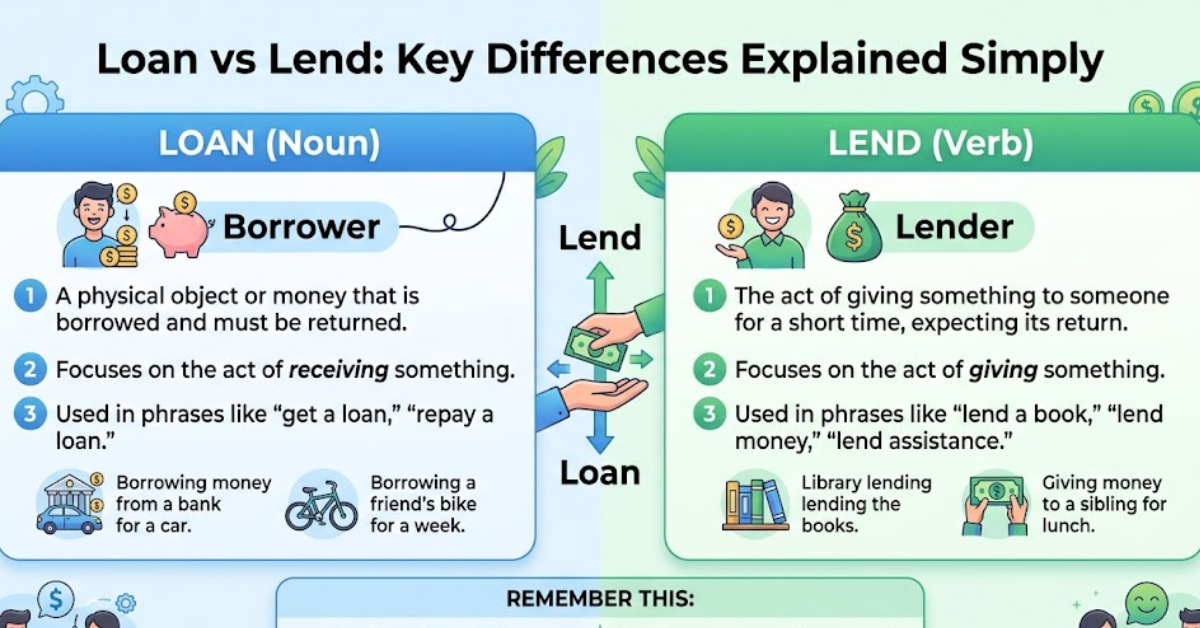
The word loan usually refers to a thing that is borrowed, especially money. It is primarily used as a noun, though in some varieties of English, particularly American English, it can also be used as a verb.
Loan as a Noun
A loan is something given to someone with the expectation that it will be returned, often with interest when money is involved.
Examples:
- The bank approved my home loan.
- She took out a student loan to pay for college.
- They offered a business loan with a low interest rate.
Common types of loans include:
- Personal loans
- Mortgage loans
- Student loans
- Auto loans
- Business loans
In financial contexts, a loan usually involves an agreement between a lender and a borrower.
What Does “Lend” Mean?
Lend is a verb that means to give something to another person temporarily with the expectation that it will be returned.
Examples:
- Could you lend me your pen?
- My friend lent me his bicycle for the weekend.
- The bank will lend money to qualified borrowers.
The past tense of lend is lent, not “lended.”
Correct:
- She lent me her notebook.
Incorrect:
- She lended me her notebook.
Loan vs Lend: The Main Difference
The easiest way to remember loan vs lend is to think about their grammatical roles.
| Word | Part of Speech | Meaning | Example |
| Loan | Usually a noun | Something borrowed | I applied for a loan. |
| Lend | Verb | To give something temporarily | Can you lend me your book? |
In simple terms:
- You lend something to someone.
- Someone receives a loan of something.
For example:
- The bank lends money to customers.
- Customers receive a loan from the bank.
Can “Loan” Be Used as a Verb?
Yes, especially in American English. It is acceptable to use loan as a verb, meaning “to lend.”
Examples:
- The library loaned me several books.
- Can you loan me twenty dollars?
However, in British English and more formal writing, lend is generally preferred when using a verb.
For example:
- British preference: Can you lend me your umbrella?
- American usage: Can you loan me your umbrella?
Both may be understood, but the choice depends on your audience and writing style.
Common Mistakes When Using Loan and Lend
Many English learners confuse these words. Here are some mistakes to avoid.
Mistake 1: Using “Loan” Incorrectly as a Noun
Incorrect:
- He gave me a lend of his car.
Correct:
- He gave me a loan of his car.
Mistake 2: Incorrect Past Tense of Lend
Incorrect:
- She lended me money.
Correct:
- She lent me money.
Mistake 3: Mixing Borrow, Lend, and Loan
Remember:
- Borrow = receive something temporarily.
- Lend = give something temporarily.
- Loan = the item or amount given, especially money.
Example:
- I borrowed money from my friend.
- My friend lent me money.
- The money was a loan.
Loan vs Lend in Banking and Finance
In the financial world, the distinction between loan vs lend is very important.
A bank or financial institution lends money to individuals or businesses. The money received is called a loan.
For example:
- A person applies for a loan.
- The bank reviews the application.
- The bank lends the money.
- The borrower repays the loan with interest according to the agreement.
This relationship between lender and borrower forms the foundation of most financial transactions.
Easy Tips to Remember Loan vs Lend
If you struggle to remember which word to use, keep these simple rules in mind:
- Lend is an action — you lend something.
- Loan is usually a thing — you receive a loan.
- A person who gives money is a lender.
- A person who receives money is a borrower.
- The past tense of lend is lent.
A helpful phrase to remember is:
“You lend a loan.”
For example:
- A bank lends a loan to a customer.
Frequently Asked Questions FAQs
Is it correct to say “loan me money”?
Yes, especially in American English, “loan me money” is considered grammatically acceptable because loan can function as a verb. In many other English varieties, “lend me money” is more common and often preferred in formal writing.
What is the difference between borrow, loan, and lend?
Borrow means to take something temporarily, lend means to give something temporarily, and loan usually refers to the thing being given, especially money.
Is “lended” a word?
No. The correct past tense and past participle of “lend” is lent.
Do banks loan or lend money
Banks lend money. The money that customers receive is called a loan. In American English, “banks loan money” is also commonly used and accepted.