Have you ever written a sentence and paused, wondering whether to use rather or whether? You’re not alone. These two words sound somewhat similar, but they serve completely different purposes in English grammar.
Understanding rather vs whether is essential for clear communication. Mixing them up can change the meaning of a sentence or make your writing sound awkward. In this guide, you’ll learn what each word means, how they’re used, common mistakes to avoid, and practical examples that make the distinction easy to remember.
What Is the Difference Between Rather and Whether?
The simplest way to understand the difference is this:
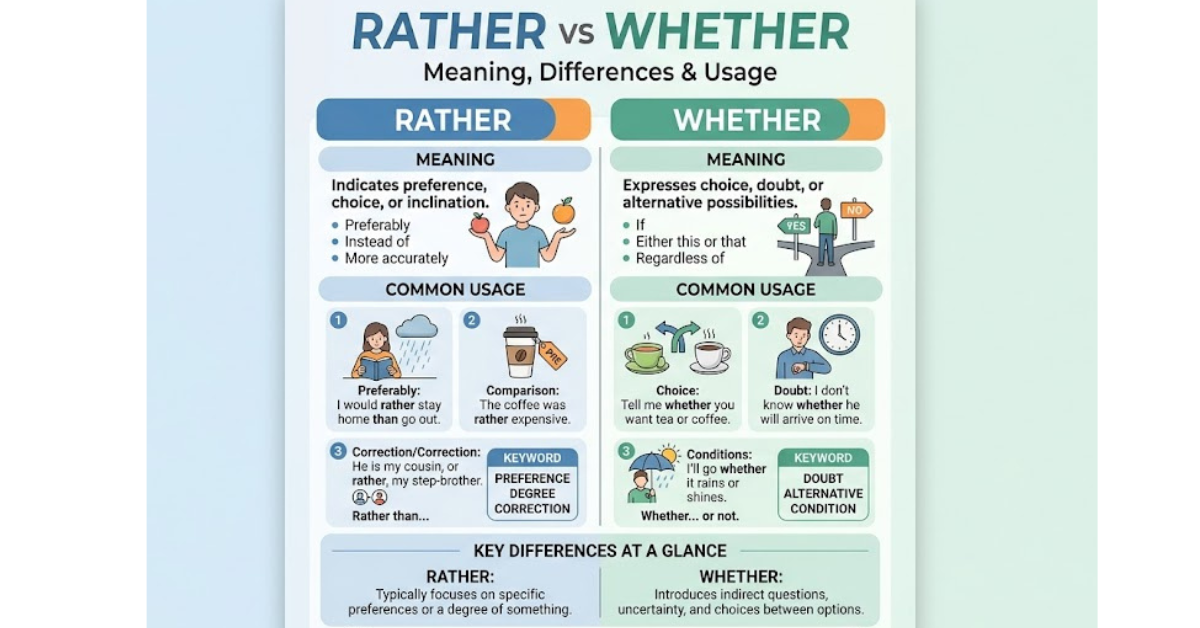
- Rather expresses preference, degree, or emphasis.
- Whether introduces choices, alternatives, or uncertainty.
Consider these examples:
- I’d rather stay home tonight. (preference)
- I don’t know whether I’ll stay home tonight. (uncertainty)
Although both words frequently appear in everyday English, they belong to different grammatical categories and cannot usually be substituted for one another.
What Does “Rather” Mean?
The word rather is an adverb used to express preference, moderation, or emphasis.
Common Uses of Rather
1. Showing Preference
This is the most common use.
Examples:
- I’d rather watch a movie than go shopping.
- She would rather travel by train.
- We would rather leave early.
In these examples, “rather” indicates a preferred choice.
2. Meaning “Quite” or “Fairly”
Rather can also mean “to a certain degree.”
Examples:
- The test was rather difficult.
- The weather is rather pleasant today.
- He gave a rather surprising answer.
Here, “rather” adds emphasis to an adjective.
3. Correcting or Clarifying Something
Examples:
- It wasn’t anger but rather disappointment.
- She’s a designer rather than an architect.
In this context, “rather” helps refine or correct a statement.
What Does “Whether” Mean?
Whether is a conjunction used to introduce alternatives, possibilities, or uncertainty.
Common Uses of Whether
1. Expressing Uncertainty
Examples:
- I don’t know whether she will come.
- We haven’t decided whether to move.
- He wondered whether the plan would work.
The speaker is unsure about the outcome.
2. Presenting Two Alternatives
Examples:
- Whether you agree or disagree, we should continue.
- The company must decide whether to expand or stay local.
- I’m unsure whether coffee or tea would be better.
3. With “Or Not”
Examples:
- Tell me whether or not you’re attending.
- We need to know whether or not the shipment arrived.
This construction is common in formal and professional writing.
Rather vs Whether: Side-by-Side Comparison
| Feature | Rather | Whether |
| Part of Speech | Adverb | Conjunction |
| Main Function | Expresses preference or emphasis | Introduces alternatives or uncertainty |
| Common Meaning | Preferably, quite, fairly | If, either/or possibility |
| Example | I’d rather stay home. | I wonder whether he’ll come. |
| Can Show Preference? | Yes | No |
| Can Show Uncertainty? | No | Yes |
When to Use Rather
Use rather when discussing what someone prefers.
Examples
- I’d rather eat at home.
- She’d rather read than watch TV.
- We’d rather take the scenic route.
Helpful Tip
If you can replace the word with prefer, “rather” is probably correct.
Example:
- I’d rather sleep.
- I prefer to sleep.
Both sentences communicate preference.
When to Use Whether
Use whether when discussing possibilities, alternatives, or uncertainty.
Examples
- I don’t know whether he’s available.
- We need to determine whether the data is accurate.
- She’s unsure whether to accept the offer.
Helpful Tip
If the sentence involves a decision, uncertainty, or an “either/or” situation, “whether” is usually the right choice.
Common Mistakes People Make
Mistake #1: Using Rather Instead of Whether
Incorrect:
- I don’t know rather he is coming.
Correct:
- I don’t know whether he is coming.
Why?
The sentence expresses uncertainty, not preference.
Mistake #2: Using Whether for Preference
Incorrect:
- I whether stay home tonight.
Correct:
- I’d rather stay home tonight.
Why?
The sentence expresses a preferred choice.
Mistake #3: Confusing Whether and If
Although “if” sometimes replaces “whether,” they are not always interchangeable.
Correct:
- I don’t know whether he’ll arrive.
- I don’t know if he’ll arrive.
However:
- The question is whether we should continue. ✓
- The question is if we should continue. ✗ (less appropriate in formal grammar)
Grammar Rules for Using Rather
Rather Than
A common expression is rather than.
Examples:
- I’d walk rather than drive.
- She chose tea rather than coffee.
- The company invested in technology rather than real estate.
This structure compares two alternatives and highlights preference.
Would Rather
Examples:
- I’d rather wait.
- He’d rather not discuss it.
- We’d rather finish the project today.
The pattern is:
Subject + would rather + base verb
Example:
- She would rather leave now.
Grammar Rules for Using Whether
Whether…Or
Examples:
- Whether you win or lose, keep trying.
- Whether it rains or shines, the event will continue.
Whether to + Verb
Examples:
- I can’t decide whether to go.
- She’s wondering whether to apply.
- They discussed whether to expand operations.
This structure appears frequently in business, academic, and professional communication.
Real-World Examples
Workplace Communication
Correct:
- The manager must decide whether to approve the budget.
Incorrect:
- The manager must decide rather to approve the budget.
Everyday Conversation
Correct:
- I’d rather order pizza tonight.
Correct:
- I haven’t decided whether to order pizza tonight.
Notice how the first sentence shows preference, while the second shows uncertainty.
Academic Writing
Researchers often use “whether” when discussing outcomes.
Example:
- The study examined whether sleep affects memory retention.
“Rather” would not fit because the sentence concerns investigation and possibility, not preference.
Easy Memory Trick
A simple trick can help you remember the distinction:
Remember the Letter “P”
Rather = Preference
Both relate to choosing what you prefer.
Remember the Letter “O”
Whether = Options
Whether introduces alternatives or possibilities.
For example:
- I’d rather stay home. (preference)
- I’m not sure whether to stay home. (options)
Key Takeaways
- Rather expresses preference, emphasis, or degree.
- Whether introduces uncertainty, alternatives, or choices.
- Use would rather when talking about preferences.
- Use whether when discussing possibilities or decisions.
- “Rather than” compares preferred alternatives.
- “Whether or not” emphasizes two possible outcomes.
Frequently Asked Questions
Is it correct to say “I’d rather” or “I’d whether”?
“I’d rather” is correct because it expresses preference. “I’d whether” is grammatically incorrect.
Can whether and if be used interchangeably?
Sometimes, yes. However, “whether” is generally preferred in formal writing and in situations involving explicit alternatives.
What is the easiest way to remember rather vs whether?
Think of rather as preference and whether as options or uncertainty. This simple distinction works in most situations.
Is “rather than” grammatically correct?
Yes. “Rather than” is a standard English expression used to compare alternatives and indicate preference.
Why do people confuse rather and whether?
The words may appear in similar sentence structures involving choices, but they serve different grammatical functions. One expresses preference, while the other introduces uncertainty.
Can whether start a sentence?
Yes. Examples include:
- Whether you agree or disagree, the decision stands.
- Whether it rains or not, the game will continue.
Conclusion
Understanding rather vs whether becomes much easier once you recognize their core functions. Rather is about preference, emphasis, or degree, while whether deals with uncertainty, alternatives, and decisions. Although they may occasionally appear in similar contexts involving choices, they are not interchangeable.
By remembering that rather = preference and whether = options, you’ll avoid common grammar mistakes and communicate more clearly in both speech and writing. Keep practicing with real-world examples, and the difference will soon become second nature.