Have you ever heard someone say, “I’m feeling very chalant today,” and wondered whether it was a real word or just internet slang? You’re not alone. Many people encounter the term online and become curious about its meaning, especially because it sounds like the opposite of the familiar word nonchalant.
If you’re asking what does chalant mean, this guide will explain its definition, origin, common usage, examples, and whether it’s officially recognized in English. By the end, you’ll understand exactly how the word is used and why it has become increasingly popular in modern conversations.
The Short Answer: What Does Chalant Mean?
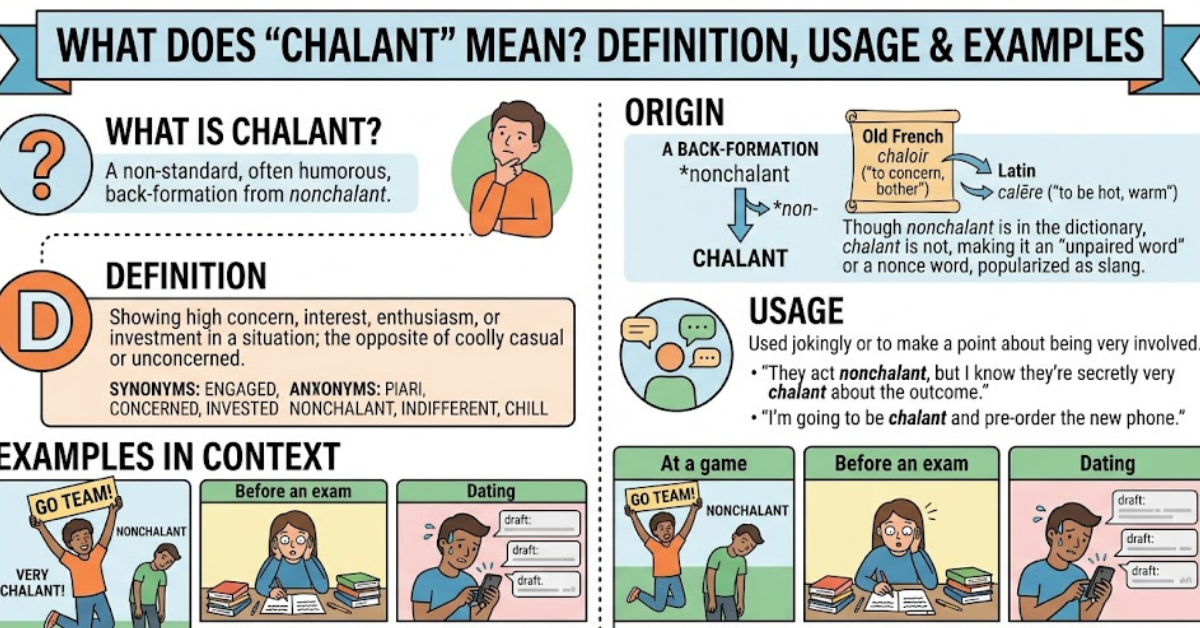
The word chalant is generally used to describe someone who is attentive, concerned, enthusiastic, or visibly interested in something.
In casual usage, people often use chalant as the opposite of nonchalant.
For example:
- Nonchalant: Calm, unconcerned, indifferent.
- Chalant: Engaged, interested, attentive, or emotionally invested.
Example sentence:
“Unlike his nonchalant coworkers, Jake was very chalant about the project’s success and followed every detail closely.”
However, there’s an important linguistic twist: chalant is not traditionally recognized as a standard English word in most dictionaries.
Is Chalant a Real Word?
This is where things get interesting.
The Traditional Answer
Historically, chalant has not been widely accepted as a standalone English word. Most major dictionaries recognize nonchalant but not chalant.
The word nonchalant comes from the French word nonchaloir, meaning “to be unconcerned.” Over time, English adopted nonchalant directly, but the positive form chalant never became common in everyday language.
The Modern Answer
In recent years, internet culture, social media users, writers, and language enthusiasts have started using chalant as a playful back-formation.
A back-formation occurs when people create a new word by removing a prefix from an existing word.
Examples include:
- Nonstop → stop
- Disgruntled → gruntled
- Nonchalant → chalant
Although not universally accepted as formal English, chalant has gained popularity in informal communication.
The Origin of the Word Chalant
Understanding the origin helps explain why the term feels unusual.
French Roots
The word nonchalant originates from French.
Breaking it down:
- Non = not
- Chaloir = to care or concern oneself
The original meaning essentially translated to “not caring.”
When English speakers later noticed the structure of the word, some assumed that removing “non” should leave a meaningful opposite: chalant.
A Linguistic Reconstruction
Unlike many English words, chalant wasn’t commonly used before nonchalant. Instead, speakers created it later to fill a perceived gap in the language.
This makes it a fascinating example of how language evolves through everyday use.
How Is Chalant Used Today?
Most modern uses of chalant appear in:
- Social media posts
- Internet memes
- Casual conversations
- Online forums
- Pop culture discussions
People often use it humorously or emphatically.
Common Examples
Here are a few examples of how people use the term:
- “Please be chalant about your deadlines.”
- “She’s definitely not nonchalant—she’s extremely chalant.”
- “I need everyone to be more chalant during this meeting.”
- “He’s very chalant when it comes to customer service.”
In these examples, chalant suggests attentiveness, concern, engagement, or active interest.
Chalant vs. Nonchalant
Understanding the contrast makes the meaning much clearer.
| Chalant | Nonchalant |
| Interested | Uninterested |
| Attentive | Indifferent |
| Concerned | Unconcerned |
| Engaged | Detached |
| Responsive | Casual or unaffected |
Example Comparison
Nonchalant:
Sarah remained nonchalant after hearing the news.
This suggests she appeared calm and unaffected.
Chalant:
Sarah was very chalant after hearing the news and immediately started asking questions.
This suggests active interest and engagement.
Why Has Chalant Become Popular?
Several factors have contributed to its growing popularity.
1. Social Media Influence
Platforms like TikTok, X (formerly Twitter), Instagram, and Reddit often popularize creative language.
Users enjoy inventing or reviving words that feel intuitive, and chalant fits that pattern perfectly.
2. The Desire for an Opposite
Many people feel that English lacks a simple opposite for nonchalant.
Words like:
- attentive
- enthusiastic
- concerned
- engaged
work in some situations, but none provide a direct one-word counterpart.
As a result, chalant fills a linguistic need.
3. Humor and Creativity
Internet language thrives on playful word creation.
Just as people use terms like:
- gruntled
- whelmed
- irregardless
they sometimes use chalant to add humor or emphasis.
Can You Use Chalant in Professional Writing?
Generally, it’s best to be cautious.
Appropriate Situations
You can use chalant in:
- Informal conversations
- Social media content
- Creative writing
- Personal blogs
- Humor-based content
Situations to Avoid
Avoid using chalant in:
- Academic papers
- Legal documents
- Formal business reports
- Professional correspondence where clarity is critical
Since many readers may not recognize the term, more established alternatives are usually safer.
Better Alternatives to Chalant
Depending on the context, you may want to use a more widely accepted word.
If You Mean “Interested”
Use:
- Engaged
- Attentive
- Focused
If You Mean “Concerned”
Use:
- Caring
- Invested
- Thoughtful
If You Mean “Enthusiastic”
Use:
- Eager
- Passionate
- Excited
These words communicate your meaning clearly in both formal and informal settings.
Examples of Chalants in Everyday Communication
Let’s look at how the term might appear naturally.
Workplace Example
“The manager appreciated employees who were chalant about customer feedback.”
Meaning: Employees who paid attention and cared about feedback.
School Example
“Teachers often prefer chalants students who participate in discussions.”
Meaning: Students who are engaged and involved.
Relationship Example
“Being chalants about your partner’s feelings can strengthen communication.”
Meaning: Being attentive and emotionally invested.
Key Takeaways
- Chalant is commonly used as the opposite of nonchalant.
- It generally means attentive, engaged, interested, or concerned.
- The word is not widely recognized in traditional dictionaries.
- Its popularity comes largely from internet culture and modern informal communication.
- It’s best suited for casual contexts rather than formal writing.
- Established alternatives include engaged, attentive, interested, and concerned.
Frequently Asked Questions
What does chalant mean in slang?
In slang and online usage, chalants usually means attentive, interested, caring, or actively engaged. It is often used as the opposite of nonchalant.
Is chalant an official dictionary word?
Most major dictionaries do not currently recognize chalants as a standard English word. However, it is widely understood in many online communities and informal conversations.
What is the opposite of nonchalant?
Traditionally, words like engaged, attentive, enthusiastic, or concerned serve as opposites. Many people also use chalants as a direct opposite.
Why do people say chalant?
People use chalants because it feels like a natural counterpart to nonchalant. Social media and internet culture have helped popularize the term.
Can I use chalant in a sentence?
Yes, especially in casual settings. For example: “She was very chalants about the event and helped organize every detail.”
Is chalant grammatically correct?
While many people understand it, chalants is not universally accepted as standard English. In formal writing, using established alternatives is generally recommended.
Conclusion
So, what does chalant mean? In modern usage, it refers to someone who is attentive, interested, engaged, or emotionally invested—the practical opposite of being nonchalant. While the word isn’t firmly established in traditional dictionaries, it has gained traction through social media, online discussions, and everyday conversation.
Language constantly evolves, and chalant is a great example of how speakers creatively fill gaps in vocabulary. Whether you use it humorously or seriously, understanding its meaning can help you navigate modern communication with greater confidence and clarity.