
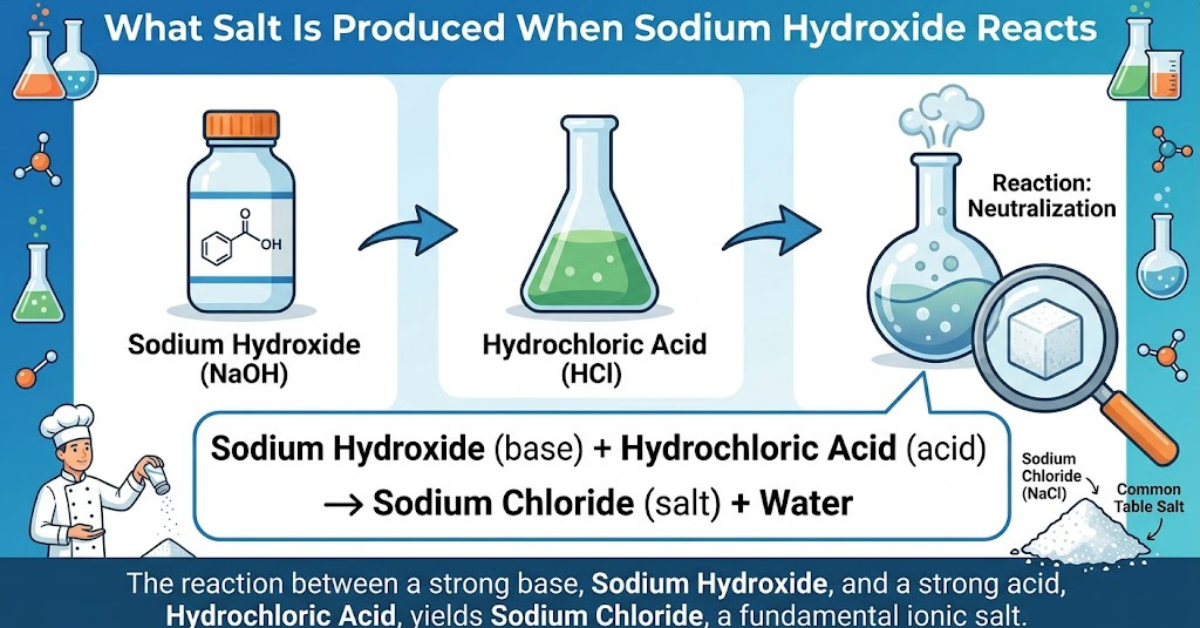
Have you ever wondered what salt is produced when sodium hydroxide reacts with sulfuric acid? This is a common chemistry question that helps explain the important concept of acid-base neutralization. When these two powerful chemicals react, they form a salt and water through a balanced chemical reaction.
The salt produced when sodium hydroxide (NaOH) reacts with sulfuric acid (H₂SO₄) is sodium sulfate (Na₂SO₄). This reaction is a classic example of a neutralization reaction, where an acid and a base combine to produce salt and water.
Understanding the Reaction Between Sodium Hydroxide and Sulfuric Acid
Sodium hydroxide is a strong base, while sulfuric acid is a strong diprotic acid. When they react in the correct proportions, the hydrogen ions from sulfuric acid combine with hydroxide ions from sodium hydroxide to create water. The remaining sodium and sulfate ions form the salt sodium sulfate.
The balanced chemical equation is:
2NaOH + H₂SO₄ → Na₂SO₄ + 2H₂O
This equation shows that two molecules of sodium hydroxide react with one molecule of sulfuric acid to produce one molecule of sodium sulfate and two molecules of water.
What Type of Reaction Is Sodium Hydroxide and Sulfuric Acid?
The reaction between sodium hydroxide and sulfuric acid is known as an acid-base neutralization reaction.
Key characteristics of this reaction include:
- An acid reacts with a base.
- A salt and water are formed.
- The reaction releases heat, making it an exothermic reaction.
- The pH moves toward neutral when the reactants are mixed in the proper ratio.
Neutralization reactions are among the most important chemical processes used in laboratories, industries, and everyday applications.
Why Is Sodium Sulfate Produced in This Reaction?
To understand why sodium sulfate is produced, it helps to look at the ions involved:
- Sodium hydroxide NaOH breaks into:
- Sodium ions Na⁺
- Hydroxide ions OH⁻
- Sulfuric acid H₂SO₄ breaks into:
- Hydrogen ions H⁺
- Sulfate ions SO₄²⁻
The hydrogen ions combine with hydroxide ions to form water:
H⁺ + OH⁻ → H₂O
The remaining sodium ions combine with sulfate ions:
2Na⁺ + SO₄²⁻ → Na₂SO₄
As a result, the final salt formed is sodium sulfate.
Properties and Uses of Sodium Sulfate
Sodium sulfate is a white crystalline inorganic compound with many commercial and scientific applications.
Common uses of sodium sulfate include:
- Detergent manufacturing – It is used as a filler in powdered laundry detergents.
- Glass production – It helps remove small air bubbles during glass manufacturing.
- Paper industry – It plays a role in certain paper-making processes.
- Laboratory applications – Anhydrous sodium sulfate is commonly used as a drying agent in organic chemistry.
Its stability and low cost make it useful across many industries.
Does the Reaction Always Produce Sodium Sulfate?
The answer depends on the amount of sodium hydroxide available. When sulfuric acid is completely neutralized with enough sodium hydroxide, the product is sodium sulfate (Na₂SO₄).
However, if there is only partial neutralization, a different salt called sodium hydrogen sulfate (NaHSO₄) can form:
NaOH + H₂SO₄ → NaHSO₄ + H₂O
Adding more sodium hydroxide then converts sodium hydrogen sulfate into sodium sulfate:
NaHSO₄ + NaOH → Na₂SO₄ + H₂O
Therefore, the final product depends on the reaction conditions and the ratio of acid to base.
Importance of Acid-Base Neutralization Reactions
Neutralization reactions like the one between sodium hydroxide and sulfuric acid have many real-world applications, including:
- Controlling the pH of industrial wastewater.
- Manufacturing chemicals and cleaning products.
- Producing various salts for commercial use.
- Performing analytical experiments in chemistry laboratories.
Understanding these reactions helps students and professionals predict chemical products accurately.
FAQs
What salt is produced when sodium hydroxide reacts with sulfuric acid?
When sodium hydroxide reacts completely with sulfuric acid, the salt produced is sodium sulfate (Na₂SO₄) along with water.
What is the balanced equation for sodium hydroxide and sulfuric acid?
The balanced chemical equation is:
2NaOH + H₂SO₄ → Na₂SO₄ + 2H₂O
This shows that two moles of sodium hydroxide react with one mole of sulfuric acid.
Is sodium hydroxide and sulfuric acid reaction exothermic?
Yes, the reaction is exothermic, meaning it releases heat as the acid and base neutralize each other.
Can sodium hydrogen sulfate be formed in this reaction?
Yes. If sulfuric acid is only partially neutralized with sodium hydroxide, sodium hydrogen sulfate (NaHSO₄) can form before further reaction produces sodium sulfate.
What are the products of a neutralization reaction?
A neutralization reaction typically produces a salt and water when an acid reacts with a base.
Conclusion
So, what salt is produced when sodium hydroxide reacts with sulfuric acid? The answer is sodium sulfate (Na₂SO₄) when the reaction reaches complete neutralization. The process follows the equation 2NaOH + H₂SO₄ → Na₂SO₄ + 2H₂O and serves as a classic example of an acid-base neutralization reaction.
By understanding how sodium hydroxide and sulfuric acid interact, you gain a stronger foundation in chemical reactions, ionic equations, and the practical uses of salts in industry and science. Explore more chemistry topics to deepen your understanding of how everyday chemical processes work.