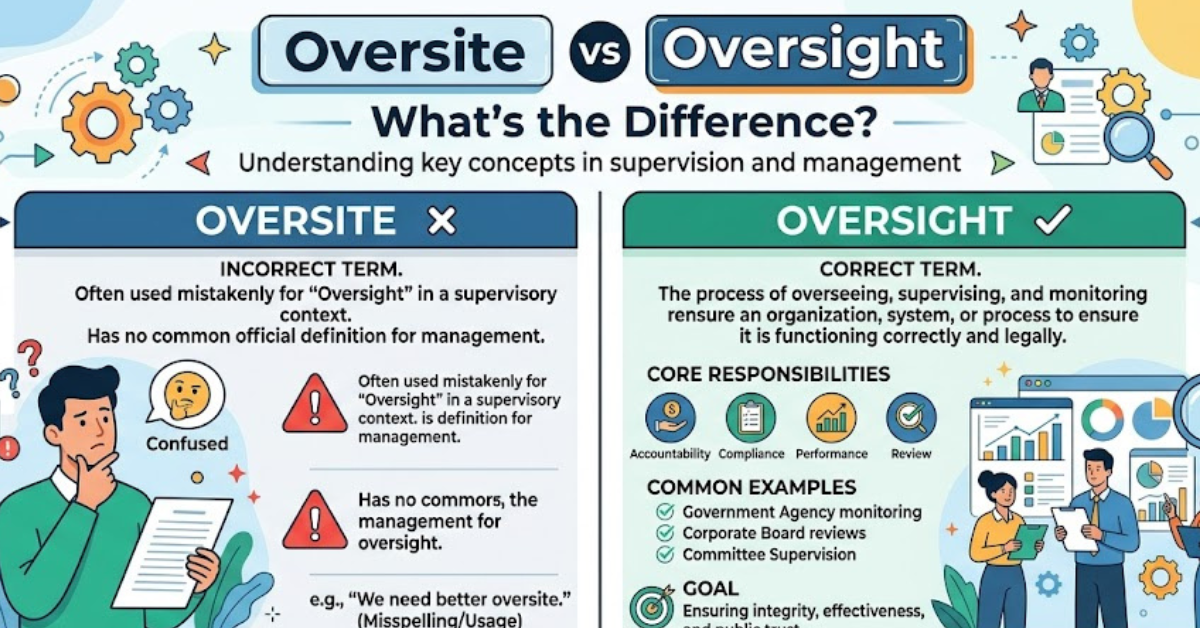
Have you ever seen the word oversite in a document and wondered whether it was correct? You’re not alone. Many writers, students, and professionals get confused by oversite vs oversight, especially because the two words look nearly identical.
The truth is that one term is widely accepted in modern English, while the other is often considered a spelling error or a specialized term used in limited contexts. In this guide, you’ll learn the meanings of both words, when to use them, common mistakes to avoid, and practical examples that make the distinction easy to remember.
Understanding Oversite vs Oversight
At first glance, the difference between these words seems minor—just one letter. However, their meanings and usage differ significantly.
Quick Definition
| Word | Meaning | Common Usage |
| Oversight | Supervision, monitoring, or an unintentional mistake | Very common |
| Oversite | Rare term; sometimes used in technical or specialized contexts | Uncommon |
In most situations, oversight is the word you’re looking for.
What Does Oversight Mean?
Oversight is a standard English word with two accepted meanings.
1. Oversight as Supervision
This meaning refers to watching over, managing, or monitoring something to ensure it functions correctly.
Examples:
- The project was completed under the oversight of senior management.
- Government agencies provide oversight for financial institutions.
- The committee maintains oversight of company operations.
In business, law, healthcare, education, and government, this is the most common use.
2. Oversight as a Mistake
Interestingly, oversight can also mean an accidental error caused by failing to notice something.
Examples:
- Leaving the document unsigned was an oversight.
- The missing data resulted from a simple oversight.
- Due to an oversight, the meeting invitation was never sent.
This dual meaning can sometimes create ambiguity, but context usually makes the intended meaning clear.
What Does Oversite Mean?
Oversite is much less common and is often mistaken for a misspelling of oversight.
Technical and Specialized Meaning
In certain technical fields, especially geology, mining, and construction, oversite may refer to:
- Material left on top after screening or filtering
- Surface-level deposits
- A layer above a specific site or excavation area
These uses are highly specialized and rarely appear in everyday writing.
Example
A geologist might write:
The oversite material was removed before excavation began.
Outside of these niche contexts, most readers expect to see oversight, not oversite.
Why People Confuse Oversite and Oversight
Several factors contribute to the confusion.
Similar Appearance
The words differ by only one letter:
- Oversight
- Oversite
When typing quickly, it’s easy to omit the “gh.”
Spellcheck Limitations
Some software may not immediately flag oversite because it can exist as a legitimate term in specialized dictionaries.
Pronunciation Similarities
Many speakers pronounce both words similarly in casual speech, making the distinction harder to notice.
Oversite vs Oversight: Side-by-Side Comparison
Meaning
Oversight
- Supervision or monitoring
- An accidental mistake
Oversite
- Rare technical term
- Refers to material or surface layers in certain industries
Frequency of Use
Oversight
- Extremely common
- Found in business, law, government, education, and daily communication
Oversite
- Rare
- Mostly limited to technical documentation
Dictionary Recognition
Most major dictionaries prominently include oversight.
Oversite may appear in specialized dictionaries but is generally absent from everyday English references.
Common Examples of Oversight in Everyday Writing
Because oversight is the standard term, you’ll encounter it frequently.
Business
- Financial oversight ensures compliance with regulations.
- Executive oversight helped keep the project on schedule.
Government
- Congressional oversight plays an important role in democracy.
- Regulatory oversight protects consumers.
Education
- The program operates under faculty oversight.
- The grading error was an oversight.
Healthcare
- Medical oversight helps maintain patient safety.
- The issue occurred because of an administrative oversight.
When Is Oversite Correct?
Most writers will never need to use oversite.
You might encounter it in:
- Geological reports
- Mining documentation
- Construction specifications
- Archaeological excavation records
If you’re writing for a general audience, business publication, academic paper, or website, oversight is almost certainly the correct choice.
How to Remember the Difference
A simple memory trick can help.
Think of “Sight”
The word oversight contains “sight.”
Supervision requires watching or seeing something.
- Oversight = watching over
- Oversight = noticing something you accidentally missed
This association makes the spelling easier to remember.
Remember That Oversite Is Rare
If you’re unsure which word to use, ask yourself:
Am I talking about supervision, monitoring, or a mistake?
If yes, the answer is almost always oversight.
Common Mistakes to Avoid
Mistake #1: Using Oversite in Business Writing
The manager provided oversite for the project.
The manager provided oversight for the project.
Mistake #2: Using Oversite for an Error
Missing the deadline was an oversite.
Missing the deadline was an oversight.
Mistake #3: Assuming They’re Interchangeable
Although similar in appearance, they are not interchangeable in standard English.
Why Oversight Matters in Professional Communication
Using the correct term improves credibility and clarity.
In professional settings, words such as:
- Regulatory oversight
- Financial oversight
- Administrative oversight
- Managerial oversight
have established meanings. Replacing them with oversite can make writing appear unpolished or incorrect.
For businesses, students, researchers, and content creators, understanding this distinction helps maintain professional standards.
Key Takeaways
- Oversight is the standard English word.
- It means either supervision or an accidental mistake.
- Oversite is a rare technical term used in specialized industries.
- Most instances of oversite in everyday writing are actually spelling errors.
- When discussing management, monitoring, governance, or errors, use oversight.
Frequently Asked Questions
Is oversite a real word?
Yes, but it is rare and mainly used in specialized technical fields such as geology and construction. Most people actually mean oversight when they write oversite.
Which is correct: oversite or oversight?
In standard English, oversight is usually correct. It refers to supervision, monitoring, or an accidental mistake.
Can oversight mean a mistake?
Yes. One accepted definition of oversight is an error caused by failing to notice something.
Why does oversight have two meanings?
English contains several words with multiple meanings that evolved over time. Context helps determine whether oversight refers to supervision or an unintentional error.
Is oversite accepted in business writing?
Generally, no. Business, legal, and academic writing almost always require the word oversight.
How can I remember the difference between oversite vs oversight?
Think of the word “sight” in oversight. Supervision involves watching or seeing, making it easier to remember the correct spelling.
Conclusion
The debate around oversite vs oversight is simpler than it first appears. Oversight is the standard and widely accepted term used to describe supervision, governance, monitoring, or even an accidental mistake. Oversite, while technically a legitimate word in certain specialized industries, rarely appears in everyday communication.
When in doubt, choose oversight. Understanding this distinction will make your writing clearer, more professional, and more accurate. Keep this rule in mind the next time you edit a report, write an email, or review content, and you’ll avoid one of the most common spelling mix-ups in English.