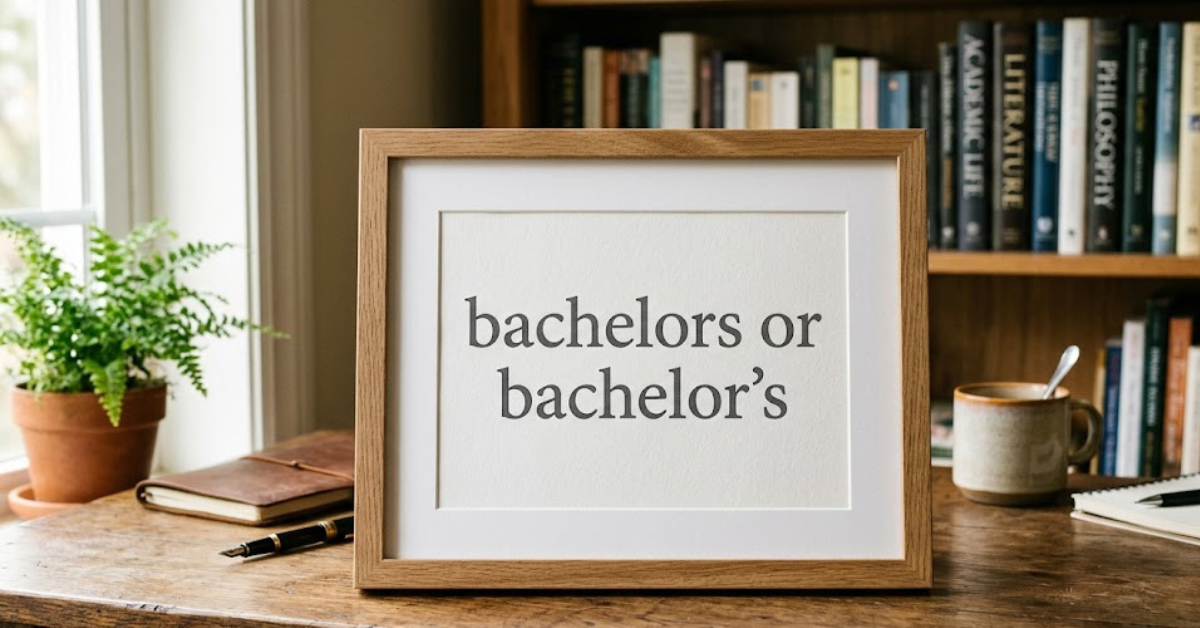
If you’ve ever paused while writing “bachelors degree” on a resume, application, or essay, you’re not alone. The question of bachelors or bachelor’s is one of the most common grammar mistakes in education-related writing.
The short answer is simple: “bachelor’s degree” with an apostrophe is usually the correct form. However, there are situations where “bachelors” without an apostrophe may appear, which is why many people get confused.
In this guide, we’ll break down the difference between bachelors or bachelor’s, explain the grammar rules, and show examples you can confidently use in academic, professional, and everyday writing.
Why People Confuse “Bachelors” and “Bachelor’s”
The confusion often comes from how the phrase sounds when spoken aloud. Since the apostrophe isn’t heard in speech, many people naturally type:
- bachelors degree
instead of: - bachelor’s degree
But grammatically, the apostrophe matters because the degree is considered a degree “of a bachelor.”
The Correct Form: Bachelor’s Degree
In most cases, the correct phrase is:
Bachelor’s degree
The apostrophe shows possession. It refers to a degree belonging to or associated with a bachelor.
Examples:
- She earned a bachelor’s degree in biology.
- I’m studying for my bachelor’s degree online.
- A bachelor’s degree is often required for this job.
This is the standard form used in:
- Universities
- Resumes
- Professional documents
- Academic writing
Is “Bachelors Degree” Ever Correct?
Technically, “bachelors degree” without the apostrophe is considered grammatically incorrect in formal English.
Incorrect:
- I have a bachelors degree in marketing.
Correct:
- I have a bachelor’s degree in marketing.
That said, many people omit the apostrophe in casual writing, online searches, or social media posts. Search engines frequently show both versions because users often type the phrase informally.
Bachelor’s vs Bachelor Degree
Another common question is whether to say:
- bachelor’s degree
or - bachelor degree
Correct usage:
- bachelor’s degree
Less common or incorrect in American English:
- bachelor degree
In standard American English grammar, the apostrophe version is preferred.
Why the Apostrophe Matters
The apostrophe in bachelor’s works similarly to:
- master’s degree
- associate’s degree
It indicates the degree belongs to a category or level of education.
Think of it this way:
- Degree of a bachelor → bachelor’s degree
- Degree of a master → master’s degree
This pattern helps maintain grammatical consistency.
Examples of Correct Usage
Here are examples showing how to use the phrase naturally.
In a Resume
- Bachelor’s Degree in Computer Science
- Bachelor of Arts in English Literature
In a Sentence
- She completed her bachelor’s degree in 2022.
- A bachelor’s degree can improve career opportunities.
Academic Writing
- Most entry-level positions require a bachelor’s degree.
Bachelor of Arts vs Bachelor’s Degree
People sometimes wonder why:
- Bachelor of Arts
doesn’t use an apostrophe, while: - bachelor’s degree
does.
The reason is grammatical structure.
Correct formal degree titles:
- Bachelor of Arts (BA)
- Bachelor of Science (BS)
These are official degree names, so they don’t require apostrophes.
General references:
- bachelor’s degree
- master’s degree
These are general education terms and do use apostrophes.
Common Grammar Mistakes to Avoid
Here are the most frequent errors related to bachelors or bachelor’s.
Incorrect:
- bachelors degree
- bachelors in psychology
- bachelor degree
Correct:
- bachelor’s degree
- bachelor’s in psychology
- Bachelor of Science
Quick Grammar Rule to Remember
A simple trick:
If you’re using the general term:
Use an apostrophe.
bachelor’s degree
master’s degree
If you’re writing the official title:
No apostrophe.
Bachelor of Arts
Master of Science
This rule works almost every time.
How Employers and Universities Write It
Most professional institutions follow standard grammar rules.
Common examples:
- “Applicants must hold a bachelor’s degree.”
- “Earn your Bachelor of Science online.”
Using the correct form makes your writing appear more polished and professional.
Why Grammar Accuracy Matters
Small grammar mistakes may seem minor, but they can affect:
- Resumes
- College applications
- Professional communication
- Academic papers
Correct punctuation shows attention to detail and strong writing skills.
FAQs
Is it bachelor’s or bachelors degree?
The correct form is bachelor’s degree with an apostrophe.
Why does bachelor’s have an apostrophe?
The apostrophe shows possession, meaning the degree belongs to the bachelor level of education.
Is “bachelors” ever correct?
Yes, but only when referring to multiple bachelors (unmarried men), not educational degrees.
Example:
- The party was full of bachelors.
Do you capitalize bachelor’s degree?
Usually no, unless it’s part of an official degree title.
Examples:
- bachelor’s degree
- Bachelor of Science
Is it master’s degree or masters degree?
The correct form is master’s degree with an apostrophe.
Conclusion
Understanding bachelors or bachelor’s is easier once you know the grammar rule behind it. In nearly all educational and professional situations, “bachelor’s degree” with an apostrophe is the correct choice.
The apostrophe signals possession and follows the same grammatical pattern as “master’s degree.” Meanwhile, official degree names like Bachelor of Arts or Bachelor of Science don’t use apostrophes because they function as formal titles.
If you want your writing to look polished, professional, and grammatically correct, remembering this small punctuation rule can make a surprisingly big difference.