English verbs can be confusing, especially when one word changes form depending on the tense. If you’ve ever wondered about become vs became, you’re not alone. Many English learners and even native speakers occasionally hesitate when choosing between these two words.
The good news is that the difference is straightforward once you understand how verb tenses work. In this guide, you’ll learn exactly when to use became, become, become or became, and even how becomes fits into the picture. By the end, you’ll be able to use these verb forms confidently in both writing and conversation.
What Is the Difference Between Become vs Became?
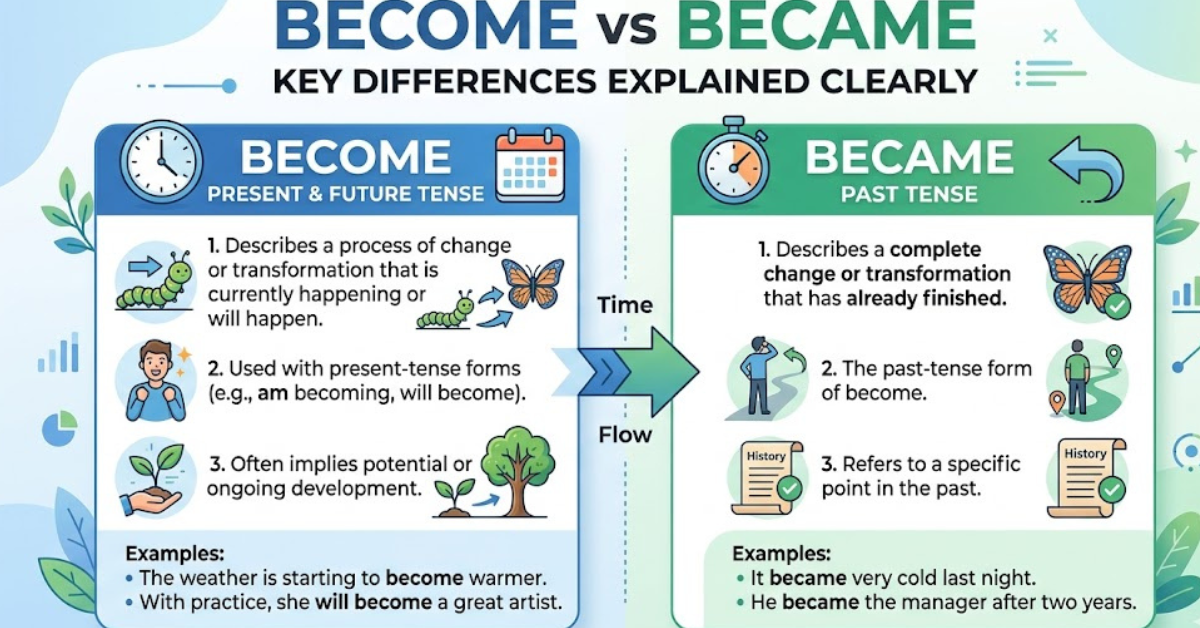
The main difference between become vs became is tense.
- Become is the base form and past participle of the verb.
- Became is the simple past tense form.
Here’s a quick overview:
| Verb Form | Usage | Example |
| Become | Base form | I want to become a doctor. |
| Becomes | Present tense (third-person singular) | She becomes nervous before exams. |
| Became | Simple past tense | He became a teacher in 2020. |
| Become | Past participle | She has become very successful. |
Understanding these forms helps you build grammatically correct sentences and avoid common mistakes.
What Does “Become” Mean?
The verb become means:
- To start being something
- To grow into a new state
- To change from one condition to another
Examples of Become
- I want to become an engineer.
- The weather may become colder tonight.
- They hope to become financially independent.
In these examples, “become” refers to a future or potential change.
When to Use Became
Became is the simple past tense of “become.”
Use became when talking about a change that happened and was completed in the past.
Examples of Became
- She became a lawyer after graduating from law school.
- The sky became dark before the storm.
- The company became profitable last year.
In each sentence, the change occurred at a specific point in the past.
Formula
Subject + became + complement
Examples:
- He became famous.
- They became friends.
- It became difficult.
When to Use Become
The word become appears in several situations.
1. Base Form After “To”
- I want to become stronger.
- She plans to become a pilot.
2. After Modal Verbs
- You can become successful through hard work.
- Technology may become more advanced.
3. As a Past Participle
After helping verbs such as “has,” “have,” or “had,” use become instead of “became.”
Examples:
- He has become an expert in marketing.
- They have become close friends.
- The situation had become serious.
Become or Became: How to Choose Correctly
When deciding between become or became, ask yourself one simple question:
Are you talking about a completed action in the past?
If yes, use became.
If no, use become according to the sentence structure.
Correct Examples
She became a doctor in 2018.
She has become a respected doctor.
She wants to become a surgeon.
Incorrect Examples
She has became a doctor.
She has become a doctor.
He wants to became famous.
He wants to become famous.
Understanding “Becomes”
Many people focus on become vs became, but it’s also important to understand becomes.
Becomes is the present tense form used with singular third-person subjects.
Examples
- He becomes anxious during interviews.
- The city becomes crowded during festivals.
- Water becomes ice when temperatures drop below freezing.
Quick Rule
Use becomes with:
- He
- She
- It
- Singular nouns
Examples:
- The child becomes tired.
- The machine becomes noisy.
Verb Forms of Become
Learning the complete verb pattern makes usage easier.
| Tense/Form | Verb |
| Base Form | Become |
| Present Simple | Become / Becomes |
| Past Simple | Became |
| Past Participle | Become |
| Present Participle | Becoming |
Examples
- I become motivated by challenges.
- She becomes excited about travel.
- They became friends quickly.
- We have become more productive.
- He is becoming more confident.
Common Mistakes With Become and Became
Many grammar errors involve mixing up the past tense and past participle forms.
Mistake #1: Using Became After “Has” or “Have”
She has became successful.
She has become successful.
Mistake #2: Using Became After “To”
I want to became a writer.
I want to become a writer.
Mistake #3: Confusing Present and Past Tense
He become a doctor last year.
He became a doctor last year.
Easy Memory Trick
A simple way to remember become vs became:
- Became = Past Event
- Become = Base Form or Past Participle
Think of these examples:
- Yesterday, I became interested in photography.
- I have become very skilled at it.
- I hope to become a professional photographer someday.
This pattern works almost every time.
Become vs Became in Everyday Conversation
Here are some real-world examples that demonstrate natural usage.
At Work
- She became the manager last month.
- She has become an excellent leader.
In Education
- He wants to become a teacher.
- He became a teacher after college.
Personal Growth
- I have become more confident over the years.
- I became interested in fitness during high school.
These examples show how the verb changes depending on the timeline of the action.
Why Understanding Become vs Became Matters
Using the correct verb tense improves:
- Grammar accuracy
- Professional writing
- Academic performance
- Everyday communication
- English fluency
Even small tense mistakes can make sentences sound unnatural. Mastering become vs became helps you communicate more clearly and confidently.
FAQs
What is the difference between become and became?
Become is the base form and past participle of the verb, while became is the simple past tense form.
Is it “have become” or “have became”?
The correct phrase is have become.
Example:
They have become successful.
They have became successful.
Can I say “to became”?
No. The correct phrase is to become.
Example:
I want to become a doctor.
I want to became a doctor.
When should I use becomes?
Use becomes in the present tense with third-person singular subjects.
Example:
- She becomes nervous before presentations.
Is became past tense?
Yes. Became is the simple past tense of the verb “become.”
Example:
- He became famous after the movie was released.
What is the past participle of become?
The past participle is become.
Example:
- She has become more experienced.
Conclusion
Understanding become vs became is essential for using English verb tenses correctly. Remember that became refers to a completed action in the past, while become serves as the base form and past participle. Meanwhile, becomes is used for third-person singular subjects in the present tense.
A quick rule to remember is: use became for past events, use become after helping verbs like “has” and “have,” and use becomes for present-tense singular subjects. With regular practice, choosing between become or became will soon feel natural.
To continue improving your English grammar, explore related topics such as verb tenses, irregular verbs, and common grammar mistakes that frequently appear in everyday writing and conversation.